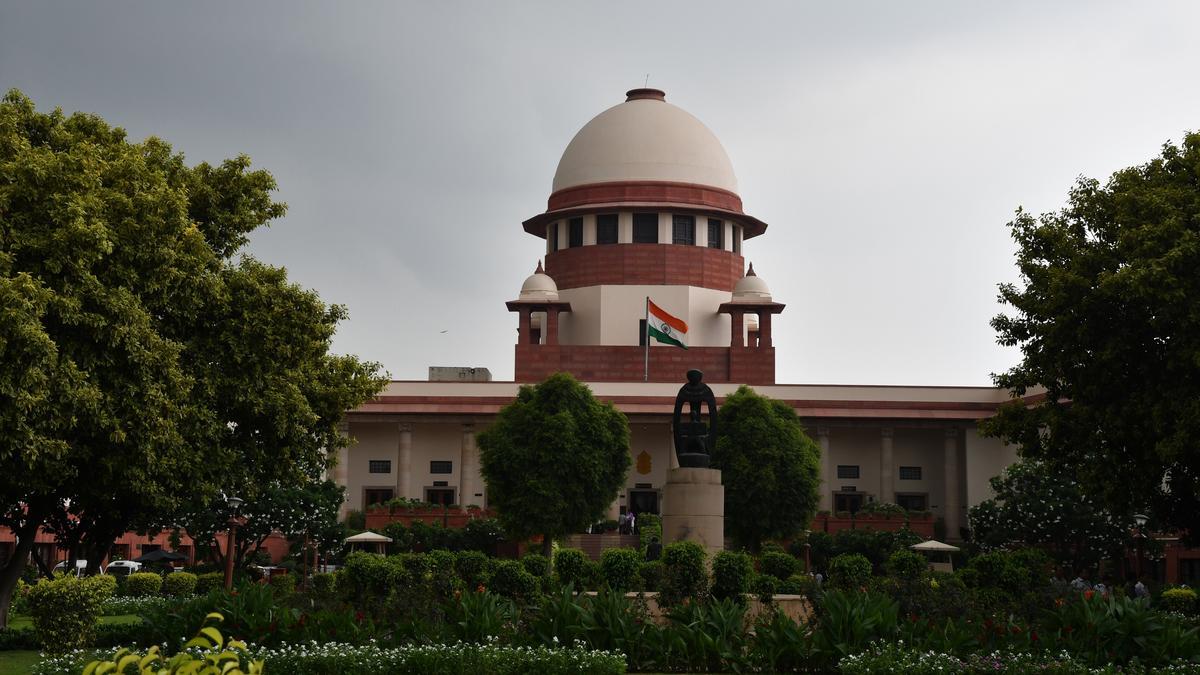
A Bench of Justices J.K. Maheshwari and Vijay Bishnoi postponed the hearing in the case of Saidai Duraisamy, who has alleged that the party used its functionaries and money to lure voters through innovative ways. File
| Photo Credit: The Hindu
The Supreme Court on Wednesday (February 11, 2026) adjourned the hearing in an appeal filed by Saidai Duraisamy, who has accused Tamil Nadu Chief Minister M.K. Stalin and the ruling DMK party of indulging in corrupt practices ahead of the 2011 Assembly election from the Kolathur constituency, citing a lack of clarity and structure in the presentation of material particulars in his pleadings.
A Bench of Justices J.K. Maheshwari and Vijay Bishnoi postponed the hearing in the case of Mr. Duraisamy, who has alleged that the party used its functionaries and money to lure voters through innovative ways that amount to corrupt practice under Section 123 of the Representation of the People Act.
Also read | Clash of titans at Kolathur: Stalin vs Saidai Duraiswamy
The Madras High Court had dismissed the allegations raised by Mr. Duraisamy for lack of conclusive evidence in 2017.
Hearing the appeal, the Bench said it was unable to analyse the findings in the judgment. It said Mr. Duraisamy’s side, led by senior advocate Dama Seshadri Naidu, had been asked to prepare brief pleadings, a chart of the documents relied on, materials connected to the findings, among others. “Nothing like this has been provided,” the Bench said. At one point, Justice Maheshwari, visibly upset, said: “This is not the only case in India.”
The Court cleared its board of cases for two days next week to hear the case. Mr. Stalin and other respondents are being represented by senior advocates Kapil Sibal, Mukul Rohatgi, N.R. Elango Shanmughasunadaram, and Amit Anand Tiwari.
The election law required a case alleging corrupt practice under Section 123 of the RP Act to be proved beyond reasonable doubt, as such allegations, if found true, would result in criminal proceedings. Mere “preponderance of probabilities” would not suffice to make a case of electoral corruption.
The Court, during the hearing, said it cannot possibly “presume” consent of a candidate to a corrupt practice under Section 123. The express consent has to be proved by the petitioner. At one point, the Bench, exasperated with the case, said “if you have difficulty in proving it, we will throw it out”.
Section 83 of the RP Act mandated that an election petition should contain a concise statement of the material facts on which the petitioner relied. The provision required the petition to “set forth full particulars of any corrupt practice that the petitioner alleges, including as full a statement as possible of the names of the parties alleged to have committed such corrupt practice and the date and place of the commission of each such practice”.
Mr. Duraisamy had said the DMK party had used the “Thirumangalam Formula” to provide money to the voters in a novel way through community feedings, courier service, currency in newspapers, and slips to purchase consumer items. A goods vehicle had been caught with boxes of currency.
The High Court had come to an “irresistible conclusion that there was no categorical averment that the 1st respondent (Mr. Stalin) had given his consent to his party functionaries to bribe the voters and self-help group members with a view to attract a misdeed of ‘corrupt practice’”. It said Mr. Stalin could not be held “vicariously liable” for the alleged act of his party functionaries.
“With regard to the allegation of money distribution by the 1st respondent’s party by adopting the Thirumangalam Formula in a novel way of community feedings, courier service, currency in newspapers, Arathi Plate contributions and slips to the voters to purchase consumer items, etc., this court points out that there is no convincing, satisfactory and acceptable proof produced on the side of the petitioner,” the High Court had said.
Published – February 12, 2026 12:18 am IST