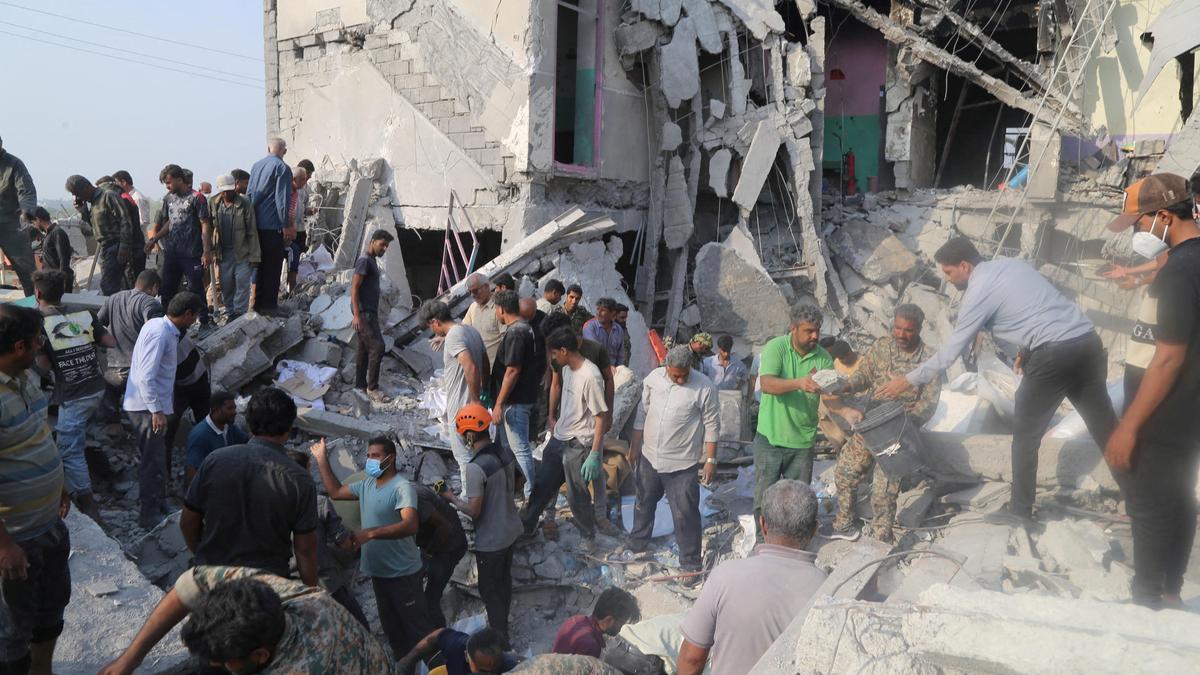
As the U.S. and Israel launched coordinated strikes across Iran, reports have surfaced that a missile had hit a girls’ primary school in the southern city of Minab, killing around 150 people and injuring nearly 100. Many of the victims are believed to be schoolchildren. UNESCO has condemned this as a grave violation of International Humanitarian Law (IHL), or the ‘laws of war’, which is designed to limit the human suffering caused during ‘armed conflict’ by imposing restrictions on the ‘means’ and ‘methods’ of warfare. Attacks on civilian objects such as schools and hospitals, and on civilians, especially children, are prohibited under IHL.
Legal justification
On February 28, Israel and the U.S. launched strikes on Iran, framing the operation as a ‘pre-emptive’ response to what they described as an imminent threat. Importantly, the UN Charter was created in 1945 following the devastation of World War II to save future generations from the “scourge of war” and maintain international peace and security. Article 2(4) of the UN Charter prohibits all member states from threatening or using force against the ‘territorial integrity’ or ‘political independence’ of another state. Under the Charter, only the UN Security Council may authorise the ‘use of force’ against a member state in response to breaches of international peace. The sole exception is Article 51, which permits the ‘use of force’ in self-defence, but only in response to an actual armed attack.
Under this legal framework, neither Israel nor the U.S. can plausibly claim to be exercising the right of self-defence against Iran under Article 51, whether individually or collectively. Notably, Iran has not recently attacked either state, and any earlier threat has long dissipated. In the absence of an ongoing armed attack, the ‘use of force’ cannot be justified as self-defence. At most, the argument rests on preventing a potential future Iranian attack — nuclear or otherwise — under the theory of “anticipatory” self-defence in response to an imminent threat.
Yet many scholars argue that international law does not recognise a right to use force in self-defence against an attack that has not yet occurred. Nevertheless, even under the broadest plausible theory of “anticipatory” self-defence, the use of force against Iran would be lawful only if three conditions were met: first, that Iran’s leadership had decided to attack the U.S. or Israel; second, that it possessed the capability to do so; and third, that the ‘use of force’ was necessary now because this was the last window of opportunity to prevent that future attack.
However, the “anticipatory” self-defence argument appears even weaker today. The U.S. strikes in June 2025 had already substantially degraded Iran’s capacity to develop a nuclear weapon. President Donald Trump had claimed that Iran’s nuclear programme had been “obliterated”. Since then, no evidence has been presented to show that Iran reconstituted its programme, formed the intent to build a weapon, mounted it on a ballistic missile, and prepared to use it against the U.S. or Israel.
Furthermore, neither regime change nor the protection of populations (Iranians) from mass atrocities by the Iranian government finds any basis in international law or the UN Charter as a lawful justification for the ‘use of force’.
IHL violations
While morals and ethics in conflicts have deep historical roots dating back to ancient Greek, Roman, Indian, and Chinese civilisations, they were codified in their modern form, i.e., IHL, by the Geneva Conventions of 1949, complemented by other treaties and customary law. IHL protects the wounded, sick, prisoners of war, and civilians while restricting brutal weapons and methods of warfare.
Unlike the UN Charter, which addresses the legality of starting a war (jus ad bellum), IHL governs how wars are fought (jus in bello) and ensures humane conduct regardless of the war’s initiation. It regulates the conduct of hostilities based on four core principles: ‘distinction’, ‘proportionality’, ‘military necessity’, and ‘precaution’.
When the missile hit the girls’ school in Iran, the ‘principle of distinction’, which requires that ‘combatants’ and ‘military targets’ be clearly separated from ‘civilians’ and ‘civilian objects’ such as schools, hospitals, places of worship, and public transport, was blatantly transgressed. Importantly, if there is any doubt about whether a target is military or civilian in nature, it must be presumed to be civilian.
The Convention on the Rights of the Child further reinforces this protection by recognising children as rights-bearing individuals and requiring States Parties, under Article 38(4), to take all feasible measures to ensure the protection and care of children affected by armed conflict. Similarly, the Rome Statute of the International Criminal Court defines the intentional targeting of civilians and attacks on buildings dedicated to education as war crimes. However, it must also be noted that civilian objects, including schools, may lose their protected status if they are used for military purposes and thereby become military objectives. For instance, a school functioning as a military base, artillery site, or command post could fall within this category. So far, however, there is no evidence that the school in Minab, Iran, was being used for military purposes or that it was deliberately targeted.
Proportionality and necessity
The key question, therefore, is how the strike should be assessed under IHL if the school was not intentionally targeted but was instead damaged as collateral harm from an attack directed at a nearby Islamic Revolutionary Guard Corps facility, as some reports suggest.
In this regard, IHL recognises that civilian objects may be incidentally affected during attacks on military objectives. However, such incidental harm to civilians or civilian objects is lawful only if it satisfies the requirements of ‘proportionality’, ‘precaution’, and ‘military necessity’.
In such circumstances — where a civilian object like a school is located near a military objective and is struck during an attack — the legality of the operation turns on whether the expected harm to the school and the children present was excessive in relation to the concrete and direct military advantage anticipated from striking the intended target.
Equally crucial is whether military commanders took all feasible precautions to minimise civilian harm, such as verifying the target, assessing the presence of nearby civilians or civilian infrastructure, selecting weapons capable of limiting collateral damage, and timing the strike in a manner that reduces risks to non-combatants.
Role of international law
In a world where states increasingly resort to force against one another, critics often point to frequent violations of international law as evidence of its irrelevance. Yet this conclusion misunderstands how international law functions. While breaches do occur, sometimes brazenly, they remain exceptions to an overwhelmingly compliant pattern of behaviour.
The everyday conduct of diplomacy, international commerce, civil aviation, maritime navigation, environmental agreements, arms control arrangements, and treaty obligations continues to operate largely within the framework of international law.
Its significance lies not in perfect compliance but in its ability to demand justification. Through its argumentative and normative practices, international law compels those who wield power to account for their actions before a global audience.
This system of accountability may be imperfect, but it ensures that departures from legal norms can be identified, scrutinised, and condemned. The challenge today is not the absence of law, but the need for states to comply with it rather than bend it to politics. For when bombs fall on classrooms and playgrounds, it is not only lives that are lost; it is the quiet extinguishing of futures that had barely begun to exist.
(Kartikey Singh is a lawyer based in New Delhi)