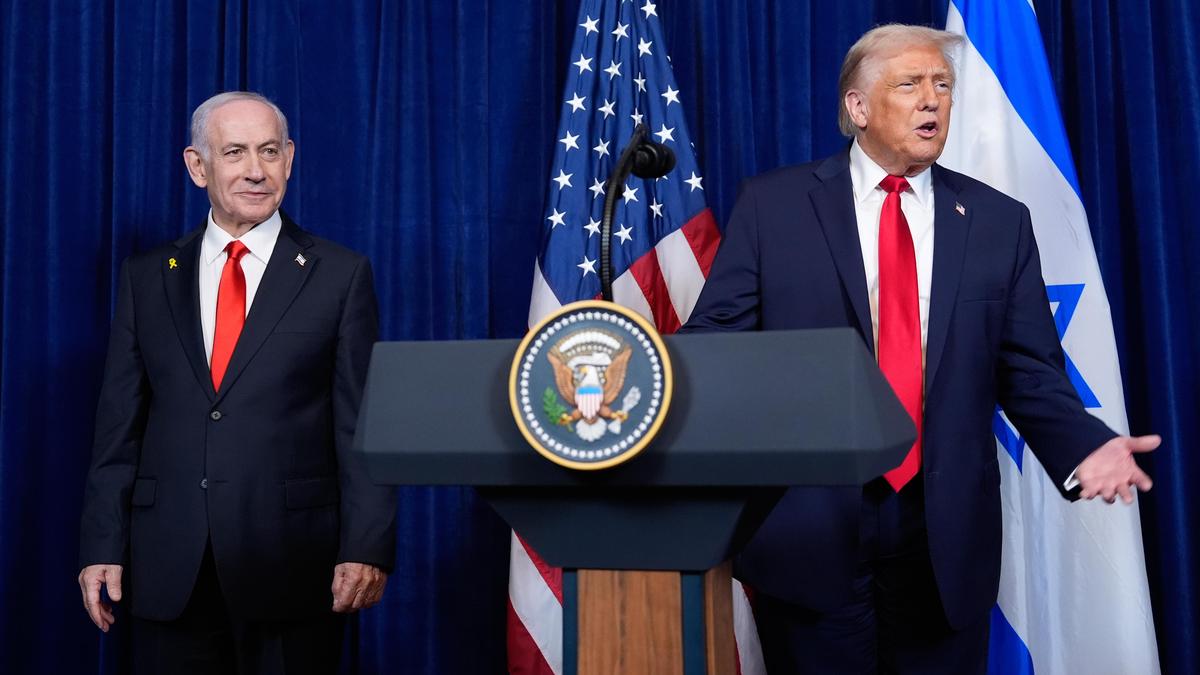
President Donald Trump answers a question from a reporter at the end of a news conference with Israel’s Prime Minister Benjamin Netanyahu at Mar-a-Lago. File
| Photo Credit: AP
(This article is part of the View From India newsletter curated by The Hindu’s foreign affairs experts. To get the newsletter in your inbox every Monday, subscribe here.)
Nearly 150 children, according to international media reports, have died so far in the US-Israel-led missile strike on an elementary school in southern Iran on February 28, 2026. Iran’s Supreme Leader Ayatollah Ali Khamenei has also been killed in the war triggered by the U.S. President Donald Trump and Israeli Prime Minister Benjamin Netanyahu, in a blatant act of thuggery. When the leaders described this reckless, all-out imperial attack as “major combat operations” and “preemptive” strikes, their claims rang hollow.
Their actions have forced Iran to respond with missile and drone attacks, targeting Israeli and American bases in the Persian Gulf and Jordan. Further, Tehran has also announced the closure of the critical Strait of Hormuz. The developments, which may widen and aggravate the ongoing war, may also lead to a major global economic fallout, particularly for countries such as India that rely on oil imports from the West Asian region.
Do read The Hindu editorial today to view these developments in perspective.
“Blood is on the hands of these two men — one a mercurial hard nationalist who is turning America into a rogue superpower, and the other, an expansionist ethno-nationalist wanted for war crimes by the International Criminal Court. Mr. Trump has bombed at least seven countries in the 13 months that he has been in office. Under Mr. Netanyahu, Israel has operated far outside the boundaries of international law,” it points out. Contending that this is “a war of choice launched to eliminate an adversary and reshape the region to suit American and Israeli interests” the editorial further noted: “Such thuggery cannot be accepted in the international system. The war machines of the imperial duo have already wrecked the region. Before the fire spreads further, this war must end.”
What does Mr. Trump really want from Iran? From Iran’s nuclear capacity to the U.S.’s desire for regime change, many factors figure in the chaos and destruction unfolding in the wake of the U.S. and Israel’s breach of Iran’s sovereignty.
Days before the attack on Iran, our Foreign Affairs Editor Stanly Johny, who is a West Asia expert, wrote on why the U.S. had mounted its largest military build-up in West Asia since the 2003 Iraq invasion. Read his analysis to understand what happened in the lead up to this war.
While, America and Israel seek regime change and a permanent shift in the balance of power in West Asia, this is a war of survival for the Islamic Republic, Stanly Johny notes in this piece ‘Iran vs Israel | Chronicles of a war foretold’.
Also read his obituary of Ayatollah Ali Khamenei, one of the most consequential figures in Iran in half a century. “Khamenei was once described by a reformist politician as the ‘Sun of the Iranian solar system’. The U.S.-Israel combine has taken out the Sun. Messrs. Trump and Netanyahu hope that the system would collapse. Iran signals that it won’t go down without a fight. West Asia faces perhaps one of its most dangerous moments in modern history,” he writes.
Responding to the developments without naming the aggressors, India said it is “deeply concerned at the recent developments in Iran and the Gulf region.” Issuing advisories to Indian citizens living in the region — millions of Indians work in West Asia — the Ministry of External Affairs said: “We urge all sides to exercise restraint, avoid escalation, and prioritise the safety of civilians. Dialogue and diplomacy should be pursued to de-escalate tensions and address underlying issues. Sovereignty and territorial integrity of all states must be respected.”
Prime Minister Narendra Modi spoke to his Israeli counterpart Mr. Netanyahu on Sunday and said in a social media post: “Conveyed India’s concerns over recent developments and emphasised the safety of civilians as a priority. India reiterates the need for an early cessation of hostilities.”
Modi in Israel
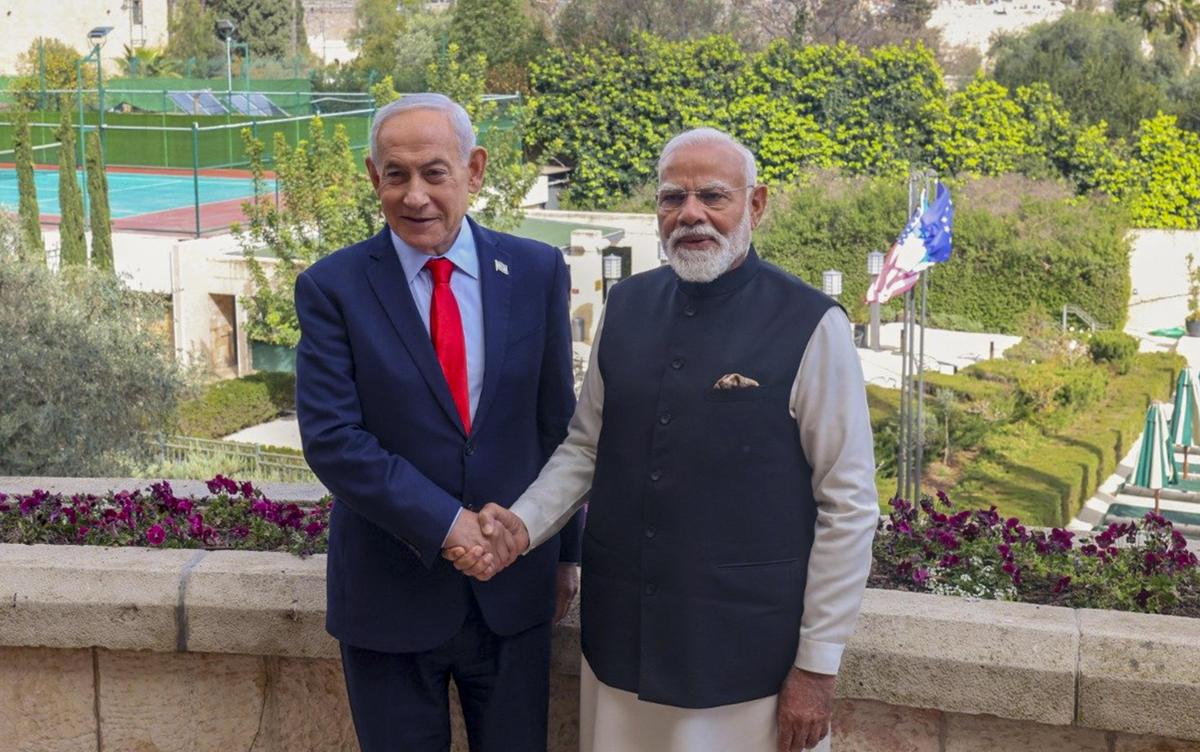
It was only last week that Mr. Modi was in Israel. Official readouts of talks between the leaders, statements and the many photo-ops, including Mr. Modi’s tight embrace of Mr. Netanyahu, accused of committing genocide against Palestinians, made global headlines.
The Hindu editorial on the visit observed that India’s decision to “stand with Israel, firmly… ” could come at the cost of India’s relations with other West Asian powers. We have to wait and see if the current aggression of the US-Israel combine, and the consequent losses to human life, prompt India to recalibrate its own position. Sometimes, even self-interest could benefit from greater moral courage.
Modi in Israel | How will it affect India’s West Asia ties? Watch the latest episode of Worldview with Suhasini Haidar
Top 5 stories we are reading this week:
- How Pakistan and the Taliban, former allies, slid into ‘open war’ by Stanly Johny
- Russia-Ukraine war at four years: key events from 2022 to 2026
- Greens win crucial U.K. by-election, upping pressure on Starmer, writes Sriram Lakshman
- Sri Lanka’s CID arrests former intelligence chief in connection with 2019 Easter bombings
- Global order in peril from lack of cooperation, says Merkel; slams China, U.S. for resisting AI regulation, writes Suhasini Haidar
Published – March 02, 2026 02:26 pm IST