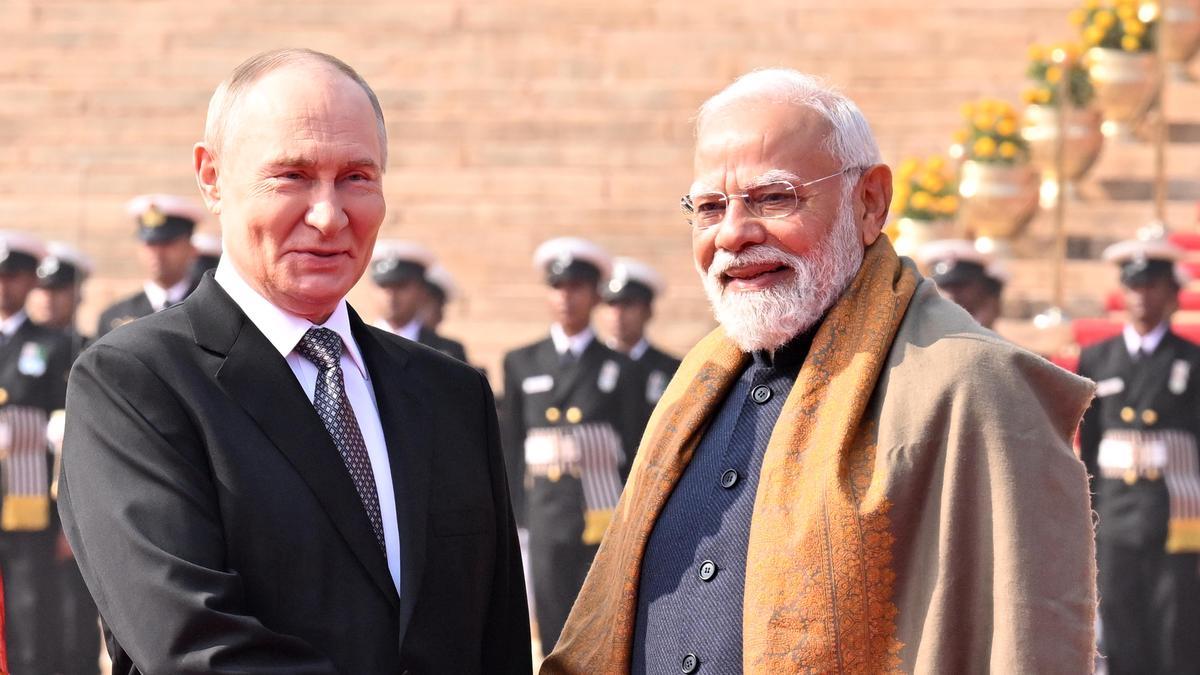
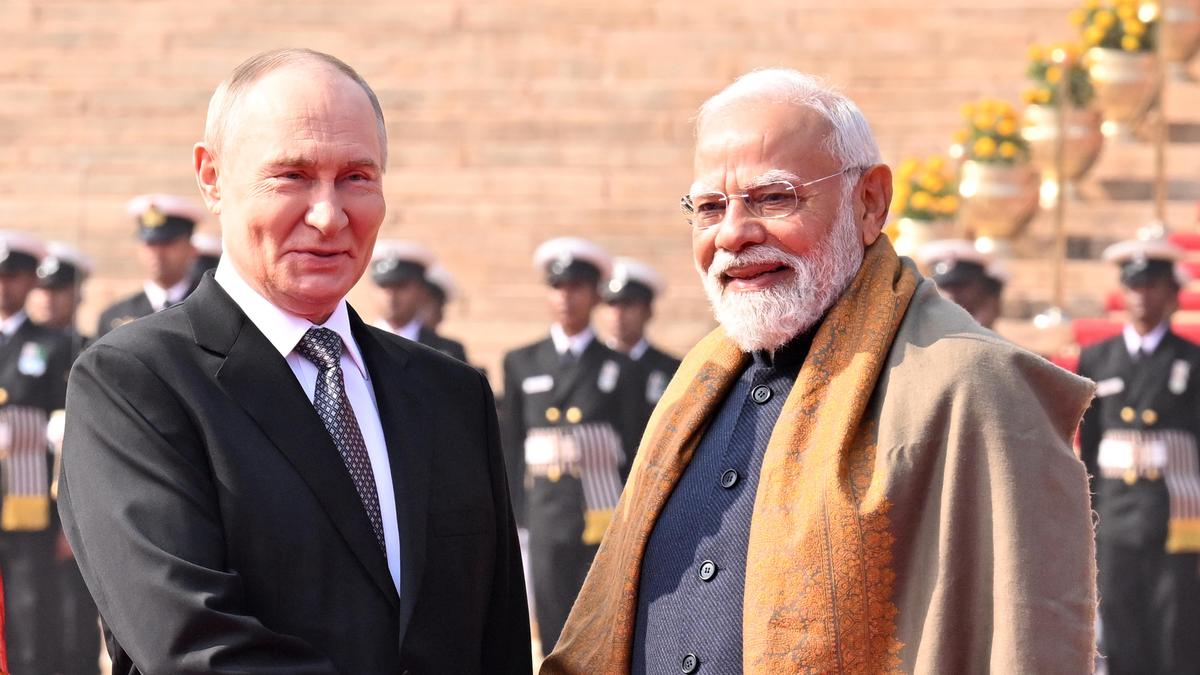
Russian President Vladimir Putin being welcomed by Prime Minister Narendra Modi during the ceremonial reception at the Rashtrapati Bhavan in New Delhi on December 05, 2025.
| Photo Credit: MOORTHY RV
(This article is part of the View From India newsletter curated by The Hindu’s foreign affairs experts. To get the newsletter in your inbox every Monday, subscribe here.)
Russian President Vladimir Putin’s visit to India drew close attention from governments and foreign policy observers worldwide. Coming amid heated debates on President Donald Trump’s “peace plan” for Ukraine, and at a time when the liberal world order is unravelling, it carried great significance.
India’s message was unambiguous, as our Diplomatic Affairs Editor Suhasini Haidar points out in this piece. She wrote: “As Prime Minister Narendra Modi walked down the red carpet at Palam airport on Thursday (December 4, 2025) to give President Putin his trademark hug as part of a grand welcome, the government signalled that India’s ties with Russia are untouched by Western concerns, the International Criminal Court’s arrest warrant, and U.S. and European sanctions.”
The optics of the visit became even more significant, in the wake of other visitors expected shortly: A U.S. trade delegation is expected this month, German Chancellor Friedrich Merz is set to visit India in early January, and the EU’s top leadership Ursula Von Der Leyen and Antonio Costa will be guests for Republic Day and the EU-India summit. In this context, can India really walk the balance with the West? Watch Suhasini Haidar’s analysis here. What are the key takeaways from Mr. Putin’s visit?
India and Russia agreed to continue working towards enhancing the settlement of bilateral trade in the national currencies of the two countries. There were no announcements, however, on oil procurement, that made up more than $60 billion of the $69 billion trade last year, nor were there any concrete outcomes on space and nuclear cooperation. In this explainer, Suhasini Haidar probes if the Ukraine war was a factor in high-level talks? Mr. Putin’s visit to India, at a time the Ukraine war could head into its fourth year, was significant, as it came during intense negotiations over a U.S.-led peace proposal aimed at ending the conflict last week in Moscow. In comments to the media prior to their talks, Mr. Modi thanked Mr. Putin for “always keeping India briefed” about the conflict, and hoping for it to end. “India is not neutral, it stands on the side of peace,” Mr. Modi said. Mr. Putin too said he hoped for peace, and signalled some hope for the U.S. proposal, she writes. However, the larger shadow over the talks was of Western sanctions on Russia that have exacted a high cost on India. While Mr. Putin promised “uninterrupted fuel supplies to India”, and the Ministry of External Affairs (MEA) has said it would only bow to “commercial considerations” on oil purchases, it would seem European sanctions on Russian and Indian oil companies as well as the hefty 25% tariff added on to Indian goods by the U.S. have dented India’s resolve, she writes.
T.C.A. Sharad Raghavan looked at India’s imports of Russian oil, and found a 38% drop in value terms, and 31% in volume terms in October 2025 as compared to last year, with the cuts driven by a high base effect as well as an overall reduction in India’s oil imports. “The latest official data from the Ministry of Commerce and Industry shows India imported $3.55 billion worth of crude oil from Russia in October 2025, down from a historically high $5.8 billion in October 2024. This is the sharpest single month drop in the value of oil imports from Russia,” he wrote.
In the latest newsletter Political Line, Varghese George zooms into the domestic political implications of Mr. Putin’s visit.
As The Hindu Editorial notes: “The omission of strategic issues from the agenda is a sign that the government remains aware of western concerns, taking care not to upset current negotiations with the U.S. and the European Union on trade agreements and high-level visits, even as Mr. Modi referred to ties with Russia as the “Dhruv Tara” (lodestar). While balancing ties with two sets of partners inimical to each other, however, New Delhi must be mindful that asserting strategic autonomy will require taking consistent steps with both, rather than pendulum movements from one to another.”
Top five stories we are reading this week:
- As cyclone impact unfolds, Sri Lanka braces for daunting recovery. At least 627 people have died so far in the devastation.
- Sam Altman | Merchant of the future – Sahana Venugopal profiles the OpenAI CEO
- The U.S Department of State has designated Cartel de los Soles (Cartel of the Suns) as a “foreign terrorist organisation”. Sruthi Darbhamulla writes on the alleged cartel
- U.K. sanctions Russia’s GRU intel agency, summons ambassador over Salisbury poisoning, writes Sriram Lakshman
- Netanyahu expects to move to Gaza truce second phase soon
Published – December 08, 2025 01:42 pm IST