Actor-producer and social activist Trupti Bhoir tears up as she recounts the gruelling experience of playing a paro (meaning a bride slave) in her Hindi film Paro. “But my tears don’t matter in front of the horrors that the real victims go through,” she says, recounting the long journey she has had with her NGO, Shelter Foundation, in shedding light on this ‘cancer’ at the heart of India.
Paro, directed by Gajendra Ahire, is an unflinching look into the lives of paros, an oppressed section of women who are sold or bartered like property by men, to become domestic slaves who have no rights, or, as a Panchayat leader in the film says, no existence even. It is a custom that is prevalent in districts of Haryana, Rajasthan and Uttar Pradesh. These women are expected to perform all duties a man must in a household, and in bed. They rear children, but have no claim over them, and can be sold whenever the master feels so. How is it different from sex work, one wonders. “Sex workers at least have the right to earn for themselves or are recognised by society,” explains Trupti. This is slavery, and as the film states, though the victims are legally protected by the Trafficking Persons (Prevention and Rehabilitation) Bill of 2016, a great deal of work remains to be done to alleviate this heinous custom. This is particularly due to the uniquely ambiguous demography and a lack of awareness.
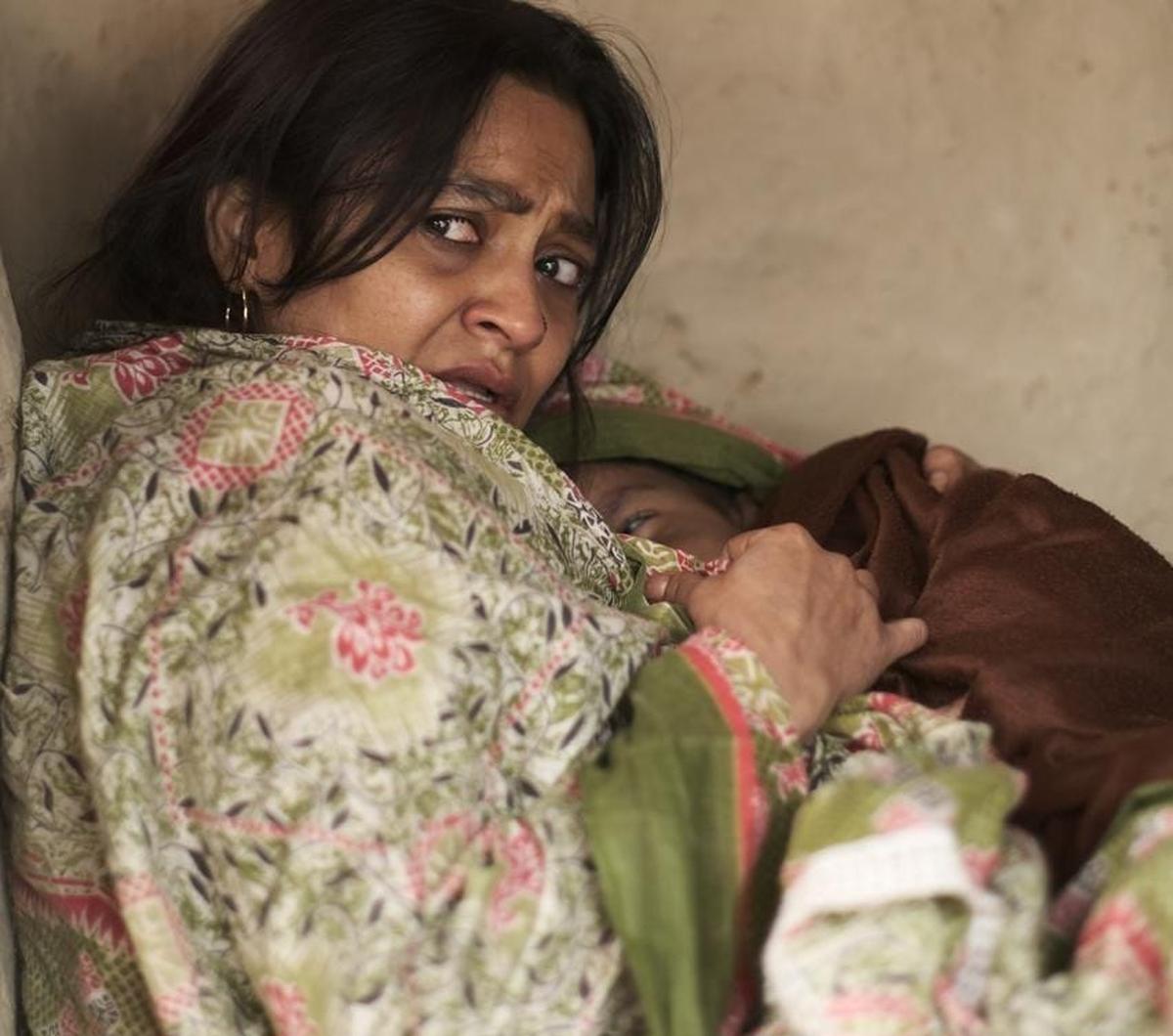
Trupti Bhoir in a still from ‘Paro’
| Photo Credit:
Special Arrangement
Produced by Trupti and Sandesh Sharda, and also starring Taha Shah Badussha in a pivotal role, Gajendra’s 100-minute film follows the story of Chaand (Trupti), who is sold from one man to another, like cattle, and faces unspeakable tribulations. A film that is bound to keep you awake at night, Paro interestingly doesn’t just resort to depicting the social evil. It also shines a torch on the light that exists at the end of the tunnel for these women — one that keeps them alive and one that warriors like Trupti hope to bring closer to their reality.
Trupti believes in using the medium of filmmaking to voice social perils. Her previous film, Touring Talkies, about the dying culture of touring cinemas, led to the removal of a law that stated such touring talkies could be functional only in villages with less than 50,000 people. Trupti found the seed to make Paro in documentary films that international news media, Al Jazeera and BBC, had made about bride slavery in India. “I was shocked. I researched and understood that it was real, but I had to see it with my own eyes.” Trupti then decided to venture into the Mewat district in Haryana, where more than 60,000 paros live (according to the makers, there are over 1,30,000 paros or molki brides in India).
But entering Mewat is no cakewalk. “Only here would you find boards that say ‘You will get gold bricks for sale’ because those are the gold that they have looted from people.” Someone even told Trupti that if a person committed 100 murders, he would end up in Mewat. “Because nobody can find you. Even if the cops had to enter Mewat for whatever reason, they would go in groups of 20 or 30.”
And so, Trupti sought the assistance of an NGO that wished to remain anonymous. “The person who helped me said that they could only do so much for the paros. He said that they could only offer a little push but that it was up to the paros to run and fight their fight.” Trupti was instructed to introduce herself as a journalist in Mewat, because “they knew that through journalistic work for the NGO, they got relief funds and clothing.” Along with some members of the NGO, Trupti and her mother visited 10 villages. “Only when I met the paros and heard the story did I realise the stark reality they were living in.”
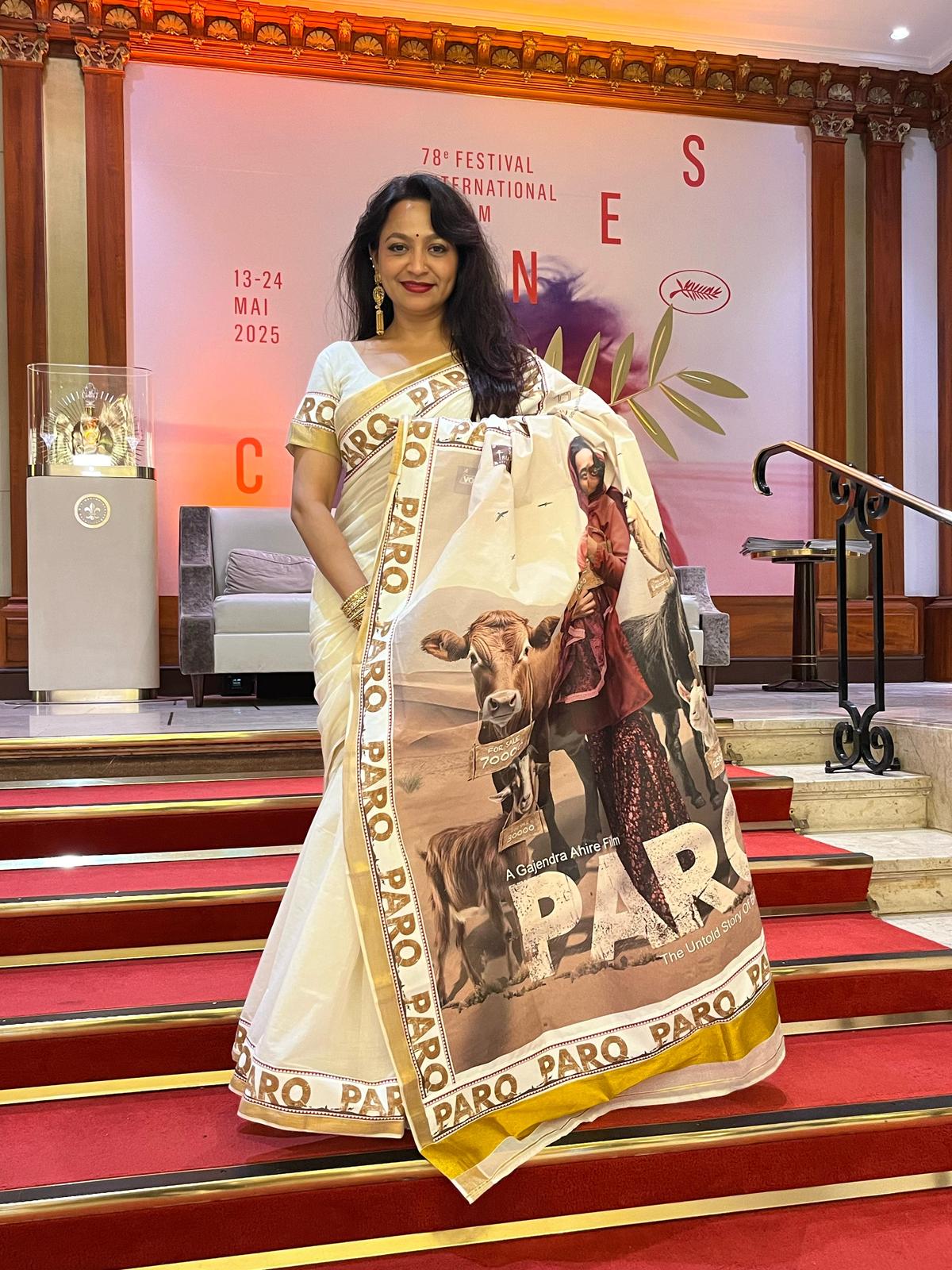
Trupti Bhoir at the 78th annual Cannes Film Festival
| Photo Credit:
Special Arrangement
“I asked a man why this was the case, and his reply was, ‘This is a place where everyone is doing paro. So to marry someone, I will have to give them a dowry, and then if something happens, her whole family will be at my house, ready to chop me into pieces. But if I have a paro, a wife for Rs 15,000 at most, I can cut her into pieces, and nobody will dare to question me.’” His response rattled Trupti. She says that she realised that poverty and gender imbalance were the culprits behind this monstrous custom. “For the men here, it’s almost a matter of pride to have a paro. You have to behave like this to be a ‘man’. What I observed is that many men as old as 70 remain unmarried, and they prefer to have young girls as paro.”
Through Shelter Foundation, Trupti and Sheetal Nikam have been working for the betterment of people who live in the most remote locations of India. After learning about the paros, they started collecting data. “Data collection is important because numbers add pressure. We went to Mewat and spent 12 days collecting data from nearly 4,000 women.” What was shocking to Trupti was how most of these women hailed from other states, like Assam, Orissa, West Bengal, Tamil Nadu, Andhra Pradesh, Kerala and Gujarat. “Mention any State in India, and you will find a bride slave from there in Mewat. They would have ended up there in different ways. Sometimes, a boyfriend would have duped and sold her off; sometimes, a poor father and mother would assume that they had married off their daughter well. Some would have been kidnapped. We realised that there is a network that’s working, especially in Delhi; the most beautiful girls they find are sold off for sex work, while others become paro,” explains Trupti.

The Shelter Foundation, over the last three years, has been assisting paros in getting Aadhaar cards. “Most of them either did not have an Aadhaar card or had one from the original State they hail from. If I have proper identity cards, I can tell the Government that they exist.”
Trupti has partnered with the women’s worker cooperative Lijjat Papad for the cause. “They are now planning on putting up a papad factory that would help these women get a livelihood.” While she cannot stop them from getting married in the first place, she is confident that they can be stopped from being resold. “What I can do is empower them. If a woman earns at least Rs. 10,000 rupees per month, she will get respect, and she will give her children a good future.” It is baffling to hear that each of the paros has more than six to eight children. “Some have more than 10. And you can find these children everywhere in Mewat. This is the future of our nation we are talking about.”
Armed with the data she collected on the ground, Trupti has been trying to get the attention of the Government. “I reached out to Annpurna Devi, Minister of Women and Child Development of India, but she hasn’t responded to us yet.”
She then approached Vijaya Kishore Rahatkar, Chairperson, National Commission for Women, who, she adds, was shocked by the fact that Trupti had managed to enter Mewat and even collect data. “She then allowed us to be a part of a meeting. I realised that this was my one chance, but I was aware that I shouldn’t be the one talking; the victims must talk. So I took two paros, and they spoke for their sisters. This was in attendance of all representatives of each State’s National Commission for Women. They said, ‘When we make some new law, it will take time. But your efforts will pay off.’” Trupti is glad that her voice has reached the authorities. “I have also written a letter to PM Narendra Modi ji. I am waiting for a response. I have faith in our Government that it will do something about these women.”

But that’s not all. To reach the masses, Trupti made Paro with Gajendra. “We shot the film in less than 16 days, in parts of Lucknow, Jodhpur, Agra, Chamba, and Pune.” The makers were conscious to ensure that people don’t mistake religion as having a role in this custom, especially since Mewat features a majority Muslim population. “Humanity is the religion that needs to be saved here. Moreover, people need to understand that Hindus are also doing this. So, it’s not about religion; this is a custom that is being practised.”
To design the lead character, Chaand, Gajendra and Trupti took inspiration from a 15-year-old paro woman they met. “She was married off to an old man when she was 12, got a child from him, and after he died, was once again sold off to another man. There, she was made to slog and slog in the field, and all she was asking was for some food. One day, the man got irritated, took her out of the house, stuffed mud in her mouth and made her eat it, before breaking her jaw. She used to sing and talk well, but she is now unable to talk properly.” In the film, Chaand’s tongue is mutilated to prevent her from speaking up for her rights. “It was also symbolic, because these women can speak, but their voices aren’t valued.”

Trupti Bhoir at the Chicago South Asian Film Festival

Shot beautifully by Krishna Soren and with an exceptional aural scape from composer Satish Chakravarthy, Paro is now among the Academy of Motion Picture Arts and Sciences’ list of 201 feature films eligible to compete for the Best Picture award at the Oscars 2026. The film was screened at the Bollywood Festival Norway 2025, the Chicago South Asian Film Festival, the Los Angeles Tribune International Film Festival, the Cannes Film Festival, and the LA Fashion Week. However, it remains unknown when the film will see the light of day in India since the Central Board of Film Certification has yet to certify it.
“A Minister asked me, ‘Why are you showing our country in a bad light?’ I said, ‘Sir, this is happening all over the world, in parts of China, Cambodia, Vietnam, Pakistan, North Korea, Mexico, Canada, the US and Russia. Last year, I was a speaker at the UN, and I realised that this was a universal problem. As per the National Human Trafficking Awareness Day’s 2023 statistics, an estimated 2,25,000 people worldwide become victims of human trafficking a year. I want India to be the first country to have the courage to tell what we are doing wrong and to alleviate it.”