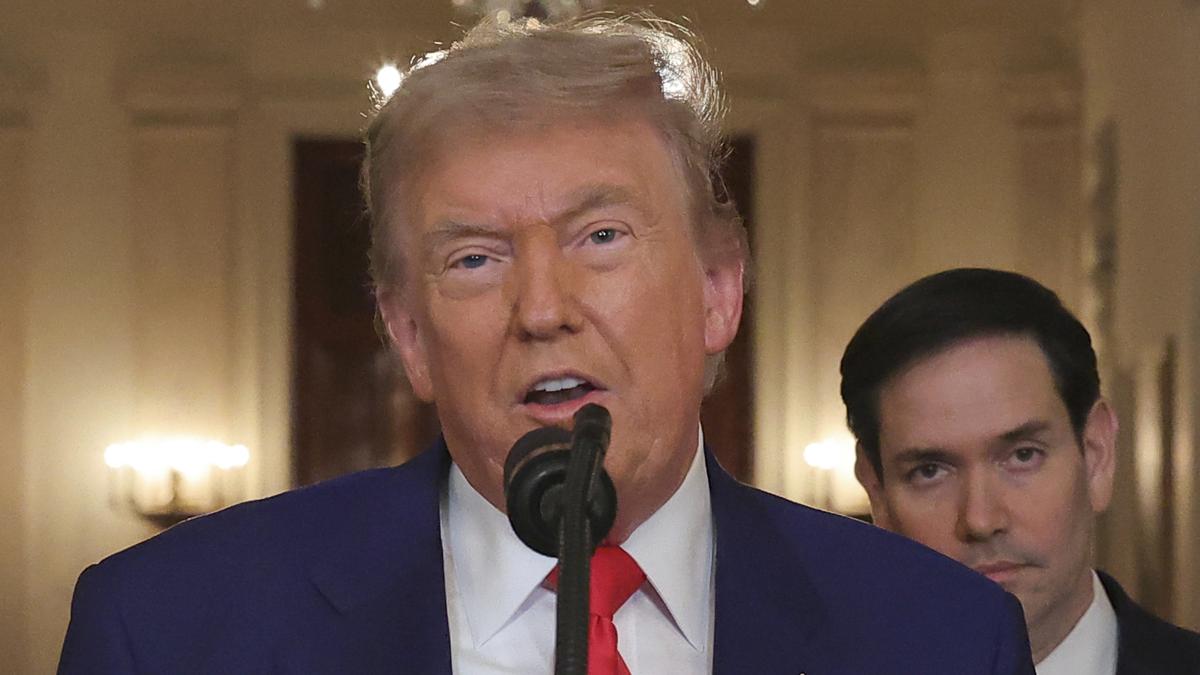
U.S. President Donald Trump.
| Photo Credit: AP
The Trump administration on Sunday (June 22, 2025) sent a series of conflicting messages to Iran — with U.S. officials initially indicating a willingness to resume negotiations after a surprise attack on three of the country’s nuclear sites and President Donald Trump talking up the possibility of regime change.
Also read: Israel-Iran conflict updates
“It’s not politically correct to use the term, ‘Regime Change’, but if the current Iranian regime is unable to make Iran great again, why wouldn’t there be a regime change?” Mr. Trump posted on social media. “MIGA!!!”
The statement marked something of a reversal from Defence Secretary Pete Hegseth’s Sunday (June 23, 2025) morning news conference when he said that regime change was not part of the mission in the aerial bombardment of three Iranian nuclear sites.
“This mission was not and has not been about regime change,” Mr. Hegseth said.
The Trump administration has made a series of intimidating statements even as it has simultaneously called to restart negotiations, making it hard to get a complete read on whether the U.S. President is simply taunting an adversary or using inflammatory words that could further widen the war between Israel and Iran.
Up until the U.S. President’s post on Sunday (June 22, 2025) afternoon, the coordinated messaging by Mr. Trump’s Vice President, Pentagon chief, top military adviser and secretary of state suggested a confidence that any fallout would be manageable and that Iran’s lack of military capabilities would ultimately force it back to the bargaining table.
Mr. Hegseth had said that America “does not seek war” with Iran, while Vice President J.D. Vance said the strikes have given Tehran the possibility of returning to negotiate with Washington.

But the unfolding situation is not entirely under Washington’s control, as Tehran has a series of levers to respond to the aerial bombings that could intensify the conflict in the Middle East with possible global repercussions.
Iran can block oil being shipped through the Strait of Hormuz, attack U.S. bases in the region, engage in cyber attacks or double down on a nuclear programme that might seem like more of a necessity after the U.S. strike.
All of that raises the question of whether the strikes will open up a far more brutal phase of fighting or revive negotiations out of an abundance of caution. Inside the U.S., the attack quickly spilt over into domestic politics, with Trump choosing to spend part of his Sunday going after his critics in Congress.
Published – June 23, 2025 03:35 am IST