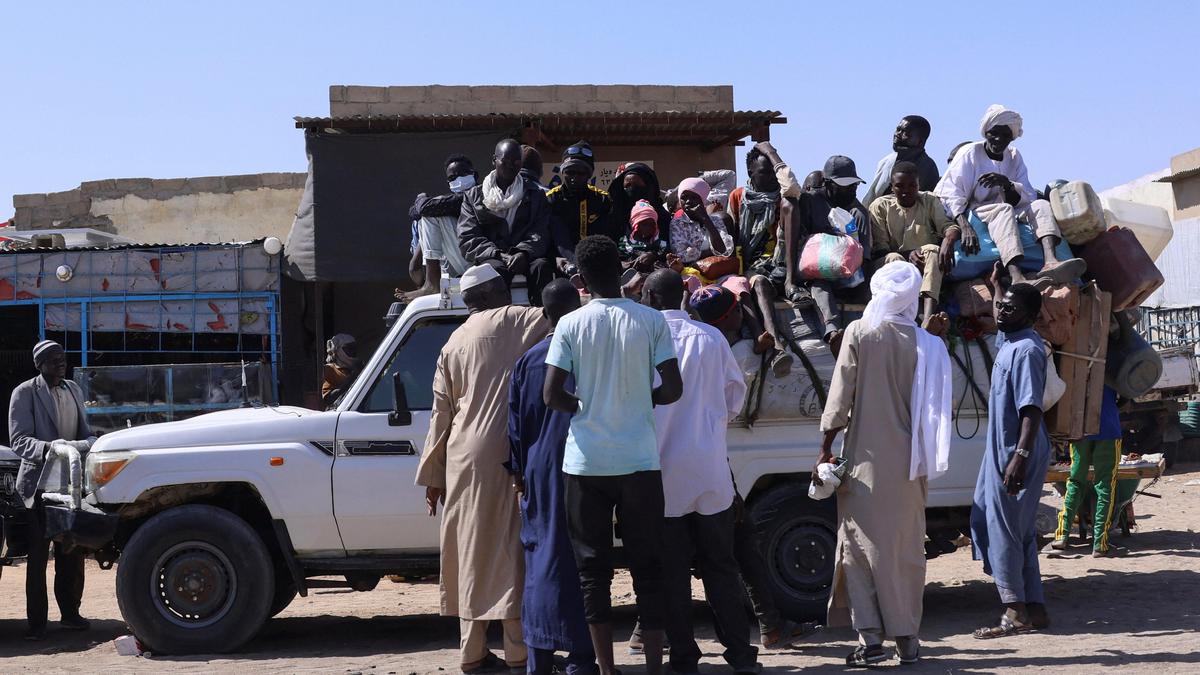
People sit on a pickup truck as they prepare to travel about 250 km south to Adre, on the Chad-Sudan border, at a transport station in Tine, eastern Chad, November 25, 2025. The movement comes amid the ongoing conflict between the paramilitary Rapid Support Forces (RSF) and the Sudanese army.
| Photo Credit: Reuters
Uganda has violated a United Nations arms embargo by deploying troops to South Sudan to support the government, according to a report published on Wednesday (December 10, 2025) by UN experts.
Localized fighting between the South Sudanese army and militias loyal to former Vice President Riek Machar, a political rival of President Salva Kiir, intensified in March. Machar’s indictment on September 11 for “crimes against humanity” has fueled fears of a new civil war.

In the report, dated late November, the panel of experts tasked by the UN Security Council with monitoring sanctions against South Sudan said Kampala had confirmed the deployment in March of soldiers from the Ugandan Armed Forces (FDPO) at the request of Mr. Kiir.
Since that initial deployment, the panel “has confirmed the arrival of additional military personnel and equipment and the expansion of the UPDF presence in South Sudan,” primarily stationed a few kilometers east of the capital.
Juba has “been able to rely on the continued support of Ugandan forces, whose armed troops, tanks and armored vehicles have remained in South Sudan since March 2025, in violation of the arms embargo” imposed by the Security Council in 2018, according to the report.
The panel said that Uganda has confirmed the deployment of three military helicopters, which also constitutes a likely violation of the embargo.
South Sudan, the world’s youngest country, gained independence from Sudan in 2011 but quickly descended into a five-year civil war between supporters of Kiir and Machar in which some 400,000 people died.
A 2018 peace deal ended the fighting and created a unity government, but its leaders repeatedly failed to hold elections or unify their armed forces.
The report described how the political and security landscape has evolved since then.
“Years of neglect have fragmented government and opposition forces alike, resulting in a patchwork of uniformed soldiers, defectors and armed community defense groups that are increasingly preoccupied by local struggles,” the panel said.

“With limited supplies and low morale, the South Sudan People’s Defense Forces has relied increasingly on relatively indiscriminate aerial bombardments as their principal means of disrupting opposition forces,” the panel added.
In May, the Security Council called for an immediate end to the fighting and expressed particular concern about reports of the indiscriminate use of barrel bombs.
Published – December 11, 2025 06:38 am IST