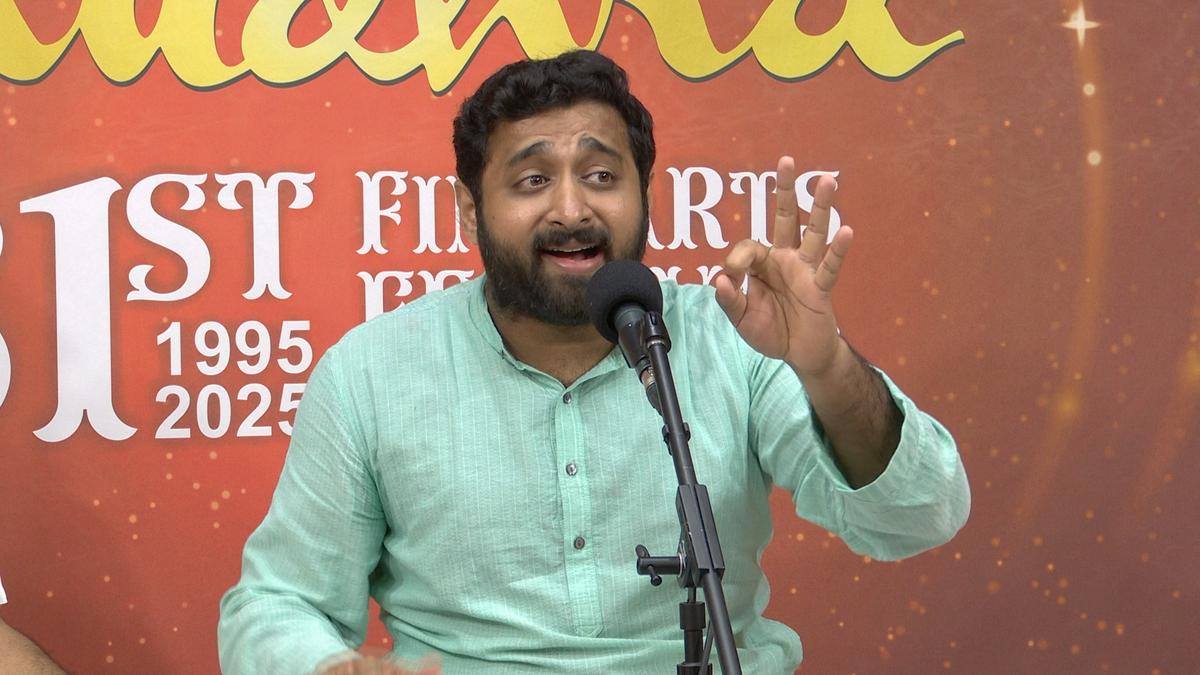
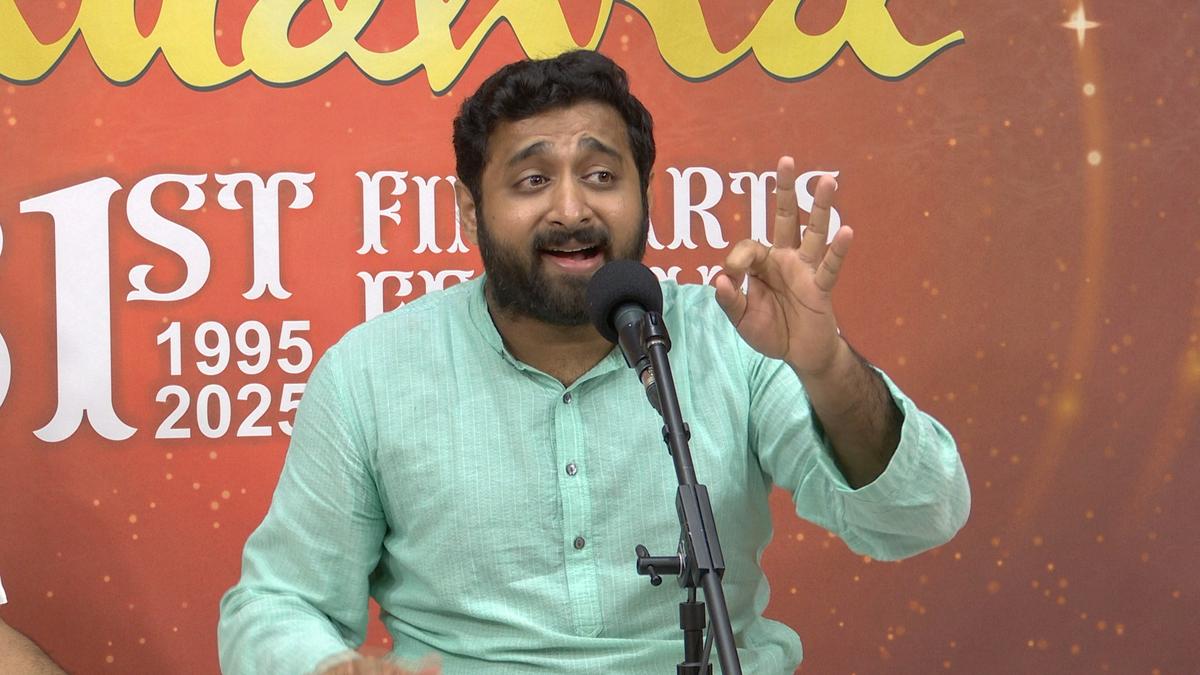
Vivek Moozhikulam presented a well-planned kutcheri.
| Photo Credit: Courtesy: Mudhra
Vivek Moozhikulam designed his two-hour concert for Mudhra in such a way that a leisurely raga is followed by one that is sprightly. This interspersion worked particularly well in the first half of his concert at Mudhra, giving his accompanists ample chance to display their skills.
Saveri was the melody Vivek chose as the sub-main. Following it up with a brisk Nagagandhari, the musician embarked upon his principal suite in Kalyani. The raga can shine even at a slow pace, but the vocalist chose to focus on its vivacity. Interestingly, this also implied a lone break in the pattern, just as the kutcheri entered the second half.
The 12-minute Kalyani alapana trod the classical path. It was refreshing even as the vocalist seldom went for a novel phrase. Vivek enjoys every bit of his singing, even when the upper ranges sometimes proved to be a struggle.
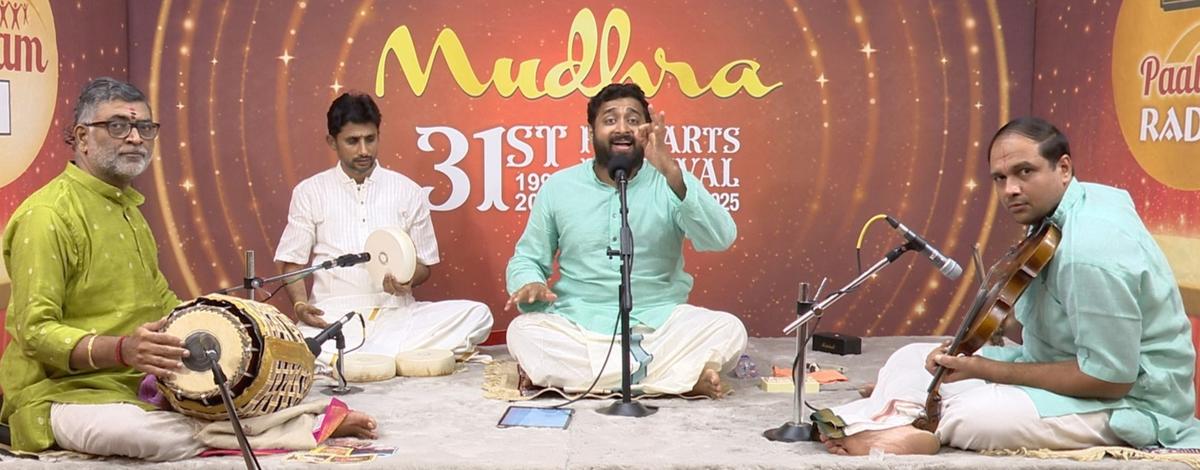
Vivek Moozhikulam with Badri Narayanan (violin), Melakaveri K. Balaji (mridangam) and Nerkunam S. Sankar (kanjira).
| Photo Credit:
Courtesy: Mudhra
On the violin, Badri Narayanan’s solo response ended with an odd slice of Sahana (and even an unwitting flash of Kanada). Tyagaraja’s ‘Etavunara’ managed to restore order, suitably backed by the percussionists: Melakaveri K. Balaji (mridangam) and Nerkunam S. Sankar (kanjira). A niraval (around ‘Shrigarudagu’) peaked too early, while the two-speed swaraprastara progressed well, but for one bit that carried a clutter of discordant notes from Vivek. The subsequent tani avartanam spanned a quarter hour, with a five-beat Khanda nadai stretch in the middle adding steam to the duo’s essay in Adi tala.
Vivek began his presentation with an Ata tala varnam in Ritigowla. The brief alapana exemplified the sweetness of his voice. The treatment of ‘Vanajaksha’ (by Veenai Kuppaiyer) demonstrated his impressive grip over microtones. These features earned further sweetness when the vocalist next sang ‘Swaminatha paripalaya’ in a peppy Nattai. This Muthuswami Dikshitar kriti taxied the kutcheri to its take-off point. And so, by the time Devagandhari came up as the third piece, the concert had earned its character and steadiness. The alapana saw its descending notes segueing into Tyagaraja’s famed ‘Ksheerasagara sayana’.
Intelligent modulations made the concert’s first niraval (‘Narimani’) doubly pleasing. The subsequent Saveri alapana generated phrases that appealed like an intimate conversation between the vocal and the violin. Restrained frills defined ‘Muruga muruga’ (Periyasami Thooran), though a couple of forays sounded tentative. ‘Sarasijanabha sodari’ came ahead of the piece de resistance.
The post-tani ditties were an unhurried ‘Taruni njan’ (Dwijavanti, Swati Tirunal) and an agile ‘Pathiki Haratire’ (Surutti, Tyagaraja).
Published – December 09, 2025 12:36 pm IST