(This article is part of the View From India newsletter curated by The Hindu’s foreign affairs experts. To get the newsletter in your inbox every Monday, subscribe here.)
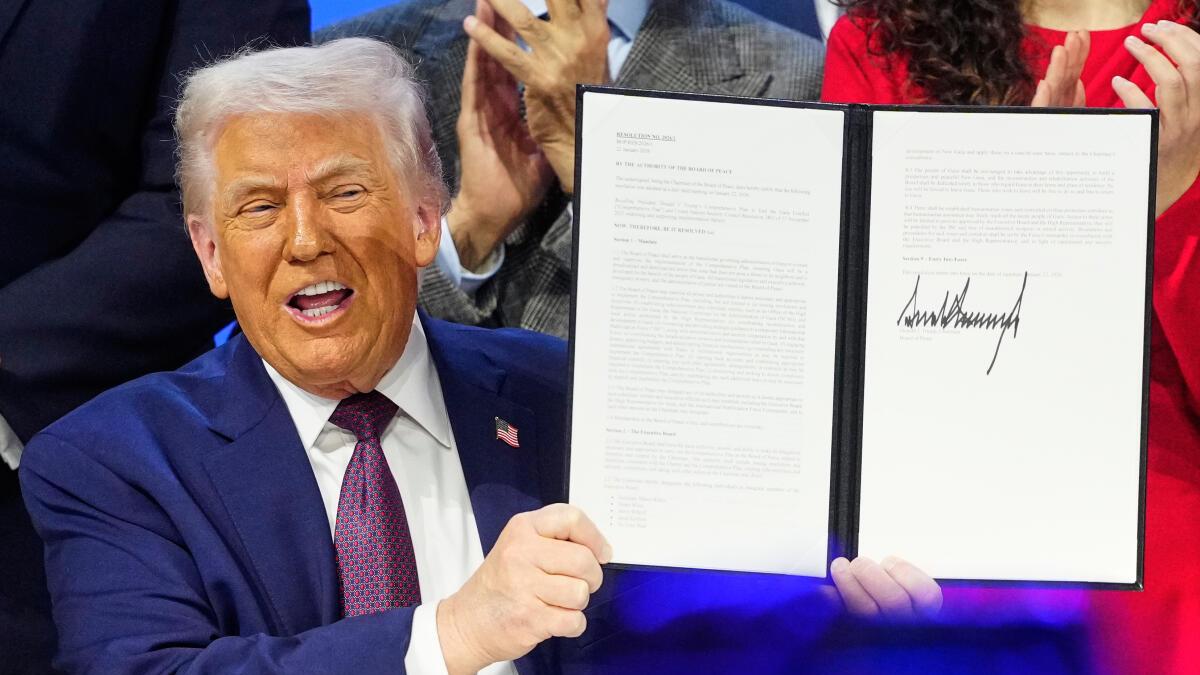
The ‘Board of Peace’ was originally proposed in the UN Security Council Resolution 2803, adopted on November 17, 2025. But the Board of Peace launched by U.S. President Donald Trump in Davos last week is markedly different from the board proposed by the UN. The UN proposal was to create a body to oversee the ceasefire in Gaza and initiatives to stabilise the Palestinian territory, including reconstruction and administration, after two years of war. The UN resolution also authorised a temporary international stabilisation force to help demilitarise and stabilise Gaza in coordination with the board, which will have reporting obligations to the UN Security Council.
But the board launched by Mr. Trump goes far beyond the mandate of Gaza. In fact, it contains no explicit mention of Gaza where the ceasefire is being violated on a daily basis by the Israeli forces. Its charter defines the board as an international organisation that would operate in conflict-affected regions worldwide. Mr. Trump is named chairman for life with extensive power over agenda, membership invites and vetoes. Membership is based on invitations, and permanent membership is offered to those countries which pay $1 billion to the board. Unlike in the UN Security Council, permanent members will not have any veto powers.
The attempt to create a large international body with permanent and invited members tasked with resolving conflicts and improving global governance has sparked concerns that Mr. Trump and his team are creating an alternative global platform to the UN. But unlike in the UN, where all member countries have equal voting rights in the General Assembly and executive decisions are taken based on multilateral consensus in the Security Council, in the Trump board, Mr. Trump would be the only boss. Even permanent members will have limited leverage over the board’s decisions. So rather than a genuine, broad-based international organisation, the board looks like the chairman’s close circle. If you want to read more about the Board, read this profile by my colleague Sruthi Darbhamulla.
The White House has sent invitations to dozens of countries to join the board. At least 20 countries have agreed to join it. Most of them are America’s close allies such as the UAE, Pakistan, Turkey, Jordan, Egypt, Saudi Arabia and Argentina. France has outrightly rejected the invitation (and Mr. Trump has threatened to put 200% tariffs on French wine); and the U.K. has said it would not join the board in its current format. India, China and Russia have also been invited. China is yet to publicly respond to the invitation. Russia is yet to take a final decision, but President Vladimir Putin said he was ready to contribute $1 billion to the board for Gaza reconstruction from the Russian assets frozen in the U.S. India said it is mulling over the invitation, but stayed away from the singing ceremony in Davos. Experts cautioned that India must consider the board’s “legitimacy” and mandate carefully, reports Suhasini Haidar. The Hindu, in an editorial, said India must eschew temptation to join the board. “Without clarity in the decision-making process of the board, members will simply be rubber-stamps to Mr. Trump’s arbitrary and often illegitimate diktats on the future of the Palestinian people. Instead, New Delhi must continue to consult partners on the best way forward, particularly the Palestinians themselves, even as it keeps its own independent counsel. Above all, while making its decision, India must listen to its own conscience,” reads the edit.
The Top Five
1. Turbulent South America builds up resistance to U.S.’s ‘Donroe doctrine’
Following the U.S military’s capture of Venezuelan President Maduro, the continent of more than 450 million people is confronting the reassertion o fa Monroe Doctrine–style logic treating it as a zone of U.S. influence; however internal divisions undermine the region’s ability to form a united front, reports Shobhan Saxena.
2. India-UAE ties — stability, substance, strategic union
The partnership is based on trust and shared interests, and stands out for its stability, writes Sunjay Sudhir.
3. Jens-Frederik Nielsen | In the eye of the storm
Greenland’s PM has to walk a tightrope between rejecting Trump’s imperial overtures and accommodating American investments and security presence while navigating domestic politics, Smriti Sudesh.
4. Nepal’s election takes shape as parties file nominations
A former Prime Minister misses out, another braces for a tough contest; ministers and mayors quit to contest the March 5 polls, reports Sanjeev Satgainya.
5. The Donroe Doctrine, Venezuela’s fragile pragmatism
Venezuela is now a subordinate partner to the U.S., and the pointer is that the Global South needs to act in concert, writes Srinivasan Ramani.
Published – January 26, 2026 06:35 pm IST