Priti Prakash, a travel blogger, had planned a vacation with her family to Dubai, an Instagrammable city of skyscrapers, beach adventures, and pure consumerism in the UAE, months before the war broke out in West Asia. On February 28, she arrived early at New Delhi’s international airport to board an Emirates flight scheduled for that afternoon. She was excited to go to the country known as the ‘land of endless possibilities’.
Soon after the flight took off, Prakash switched on the in-flight entertainment service. She noticed then that most of her co-passengers were glued not to movies, but to CNN’s live coverage of the unfolding situation in the region. Israel and the U.S. had jointly attacked Iran, plunging the region into chaos.
Iran-Israel war LIVE
“It was a strange feeling,” says Prakash. “The war had broken out when I was busy at security check and immigration.”
By the time the aircraft reached the Gulf — an important waterway that is an extension of the Indian Ocean and is bordered by eight countries, including the UAE — Prakash learned that the story had shifted from just Iran to the entire region. It appeared that in retaliation to the attacks by Israel and the U.S., which had killed the Supreme Leader of Iran, Ayatollah Ali Khamenei, Iran had hit Qatar, the UAE, and Bahrain, expanding the scope of the war. As a result, Dubai airport, the world’s busiest for international travel, with a record 9.23 crore passengers passing through its terminals in 2024, had also become vulnerable. Everyone on board had started praying.
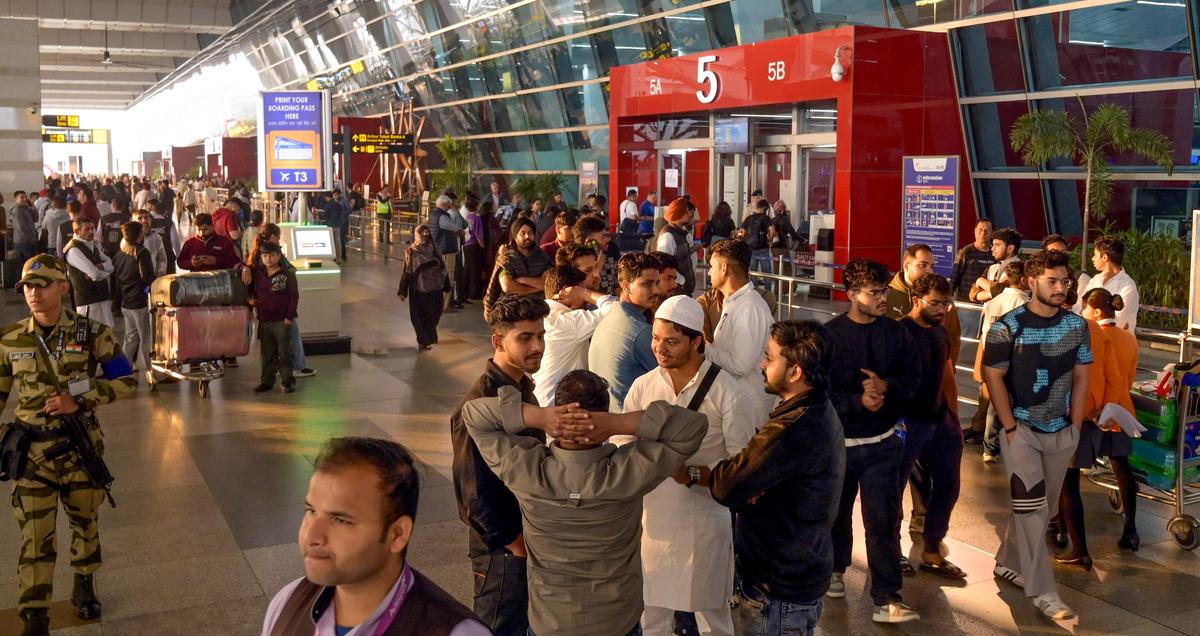
Passengers at the New Delhi international airport after several flights were cancelled due to the conflict on March 2, 2026.
| Photo Credit:
The Hindu
“The pilot announced that the aircraft had been instructed by flight control to stay out of Dubai’s airspace,” she says. “So, he kept circulating over Oman. After 30-40 minutes of flying aimlessly, we were finally allowed to land in Dubai.”
The war had been long in the making. Israel and Iran have shared an acrimonious past that began immediately with the founding of the Islamic Republic in 1979. Decades of bitterness exploded in June 2025 when the two sides exchanged missiles in the so-called 12-day war. The war of 2026, however, has been unprecedented, as Iran’s retaliation has followed the lines Tehran had promised during the last conflict, when it warned that any further violation of Iran’s sovereignty would draw the entire region into war.
Within the first 24 hours of being attacked, Iran fired missiles and drones at all the U.S. bases located in Jordan, Kuwait, Bahrain, Qatar, the UAE, Saudi Arabia, and Israel. The expatriate community of workers, a vast majority of them blue-collar as well as white-collar professionals from South Asia and Southeast Asia, came within the strike range of missiles and drones from Iran.

Stranded in paradise
After they landed, Prakash and her family frantically began making plans to leave Dubai as soon as possible. By then, the war had already claimed more than 200 lives. This included at least 180 children at a girls’ elementary school in Minab, Iran, which had been bombed.
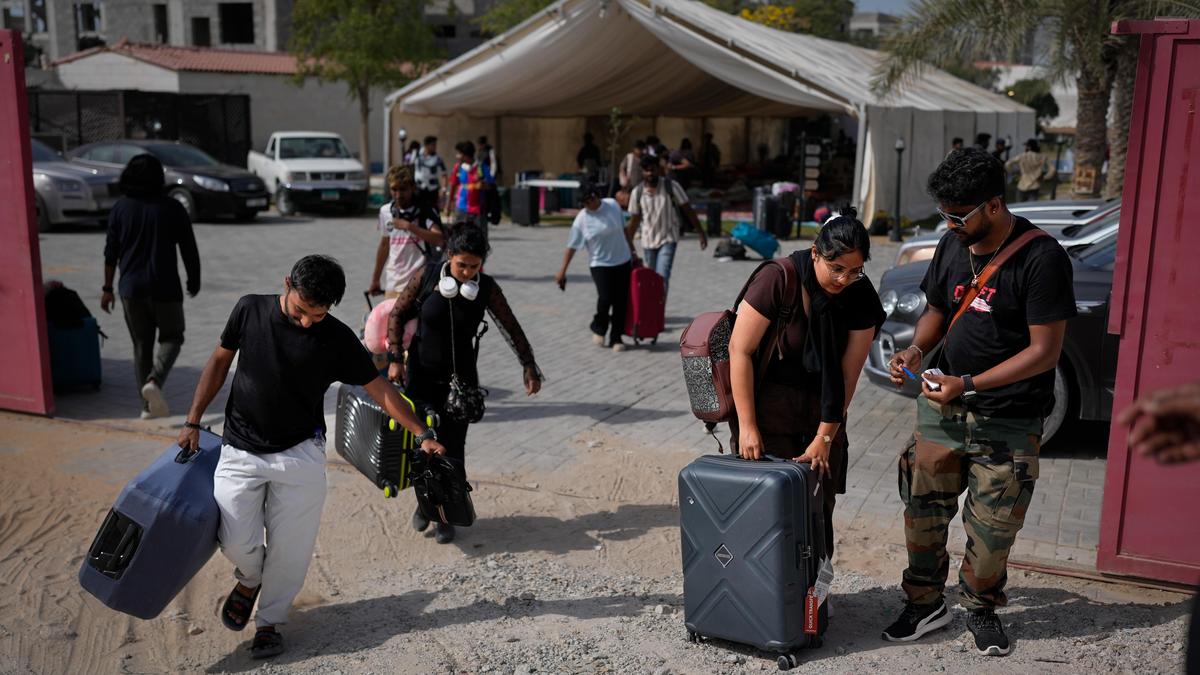
Dubai, considered a human-created paradise, was filled with the sound of sirens. Anxious people spoke of their fears of falling missiles and debris. Prakash cancelled her plans of going sightseeing and spent most of her time talking to people in the hotel. But planning a way out was difficult: all the flights out had been cancelled. Dubai, an aviation hub, was brought to a standstill as all aircraft had been grounded. Like Prakash, thousands of Indians were stranded in multiple locations in the Gulf.
The UAE government responded with generosity, promising the tourists who were stranded that they would not be thrown out of their hotels. “Hotels received a general order from the government that no one should be thrown out for overstaying,” says Prakash. “But when we asked the hotel, the manager told me that that order was specific only to the capital, Abu Dhabi, and did not apply to the rest of the Emirates.” She says they had to pay more for the extra two days that they had to spend before returning to India.

Stretched to its limits
According to the Ministry of External Affairs, 90 lakh-1 crore Indian expatriates live and work across the six Gulf Cooperation Council (GCC) countries — Saudi Arabia, Kuwait, the UAE, Qatar, Bahrain, and Oman — constituting the largest foreign workforce in the region. The Indian government issued safety advisories for expatriate workers, but the conflict has also left many Indians travelling in the region for tourism or business, stranded.
Brijmohan Singh Raghuvanshi, a journalist with Sadhna News, was trapped in the Israeli capital, Tel Aviv. He had arrived in Israel to cover Prime Minister Narendra Modi’s visit just days before the war. Soon after, the outbreak of the war left him stuck in the country.
“When the Prime Minister’s visit ended, we planned to stay a little longer before returning to India. Suddenly, we received emergency alerts asking us to rush to underground bunkers. It came as a surprise,” says Raghuvanshi. He adds that despite being a battle-ready state, Israel was jolted this time as Iranian missiles had managed to evade Israel’s famed Iron Dome, a multi-mission system capable of intercepting rockets, artillery, mortars, precision-guided munitions, aircraft, helicopters, and unmanned aerial vehicles at ranges of up to 70 kilometres.
“We were hearing the sound of missiles being intercepted in the air. At times, some of the blasts sounded like missiles hitting the ground. But no one would tell us whether these hits were causing casualties as Israel is under a state of emergency,” he says. Under such conditions, he explains, it is difficult to get verifiable reports about how the war is affecting the Israeli public. Barring a few handful news outlets such as Ha’aretz, most of the mainstream Israeli media has been unable to provide a clear picture of the ground reality. It is foreign workers in Israel who have been posting on social media about the situation.

Police and rescue services were active on the streets, carrying out operations, but Israeli authorities released no casualty figures from the missile strikes, Raghuvanshi says.
Tired of getting no answers to any of his questions, he hired a cab and requested the driver to take him to a spot where some missiles had fallen on the second and third days of the conflict.
“The driver took me to a place where four large buildings had turned into rubble. We saw rescue services on the spot. They claimed that only one person had died. But looking at the extent of the destruction, it seemed highly unlikely that the casualty figure would be that low,” he says. Raghuvanshi spoke to residents of the area, who told him that the toll was higher.
He says there was a surge in prices across Israel, which has made life harder for Indian workers and students. The prices of essentials such as water and milk have soared since the fighting began. “A bottle of water cost about 12 shekels (₹350) a few days after the war began,” he says.
Ratnadeep Chakraborty, a PhD student at Tel Aviv University, who saw the war in June 2025, is experiencing the current conflict as well. He says he has observed Israel’s operations during both. “The war of June 2025 appeared more intense as it was focused on Israel. This time, there have been fewer hits, but the war is much bigger as the entire region has been plunged into conflict,” Chakraborty says over a call. Like Raghuvanshi, he also speaks of the burden of price rise.
The Indian population in Israel has shot up over the past few years, especially after October 7, 2023, when Hamas-led militants poured into southern Israel from Palestine, killing some 1,200 people and abducting 251. Israel reduced the number of Palestinians working in its economy. The rise of Indians is mainly because the Israeli economy is absorbing more Indian workers in the agriculture and construction sectors, where there is a demand for labour. According to the Ministry, the number of Indian blue-collar workers in Israel is around 30,000.
Raghuvanshi says the war has stretched Israel’s defence capabilities. On visiting missile impact sites, he found that while Israel may have managed to restrict information about casualties under emergency rules, Israelis have also been victims of the conflict.
Comment | Is India tailing the U.S. in its West Asia policy?
Living in stress
The Indian population in Iran is relatively small, concentrated mostly in Qom, Tehran, and Bandar Abbas, the biggest port of the country.
Annie Mirza, who hails from Lucknow, had got caught, along with her mother, in the 12-day missile war last year. She had gone to Iran on a pilgrimage and was in Qom when the war had started. “This year, the war is much bigger as the Rahbar [Ayatollah Khamenei] was assassinated,” says Mirza, who is concerned about the wellbeing of her relatives in Kuwait, Qom, and Tehran.
Mirza spent considerable time in Iran last year before being evacuated with the help of the Indian embassy. She says the people of Iran are different from what the western mainstream media portrays. “Iranians are a proud people and they believe in a life of dignity. It is important for them to live with their heads held high,” she says.
Her relatives have been unable to contact her often due to an internet outage in Iran and communication restrictions in Kuwait. Kuwait has maintained strong defence ties with the U.S. since its liberation from Iraqi occupation in 1991, but a telecommunications law that gives the government sweeping powers to block content and deny access to the Internet has made staying in touch harder.
“My cousin spoke to me over a WhatsApp call on Thursday (March 12, 2026) and she said the U.S. embassy and the military base were being bombed by Iranian drones from the morning,” says Mirza. Her relatives in Kuwait City are living in stressful circumstances as drones and missiles keep hitting the U.S. base, she says.

Providing protection
While there are no reports of Indians getting hurt in the U.S.-Israeli bombing of Iran, the plight of Indian sailors in merchant navy ships and oil tankers is of concern for the Indian government.
So far, five Indians have died in Iranian drone and missile attacks on oil tankers in the Strait of Hormuz and one is missing (presumed to be dead). At least 35-40 have been injured in attacks, officials from the Ministry said, even as India continues to call for an end to strikes on civilian vessels in the region.
Ashish Kumar, who was the captain of the ship MV SKYLIGHT, was killed when the ship was targeted by a projectile off the coast of Oman. Kumar and another Indian sailor were initially declared missing. Subsequently, the Ministry announced that he had died in the attack. His family, in Bihar’s Bettiah, was informed over email about the circumstances in which he died, but they remain unconvinced that he is no more.
“The government sent us an email saying human remains were found in the captain’s cabin. We need further forensic information before believing the news,” says Ashish Kumar Verma, Kumar’s brother-in-law. Official sources say forensic details about the recovered human remains from the captain’s cabin of the ship can be shared only after more official and legal processes are completed in Oman, which is looking into the matter.
While India continues to hold phone calls with the Iranian foreign minister, Seyed Abbas Araghchi, the real worry continues to be the sheer size of the expat Indian population that works in the region, who will face a security threat for as long as the war continues. According to officials, it is not possible to evacuate such a large number of people in a brief span of time.
Prakash says the war seems to have surprised the Indian missions in the region. “I visited the Consulate General of India in Dubai and requested for a meeting with the Consul General to get help and updates. There were 50-70 people at the gate but no one came to help. I tried to contact them on WhatsApp, email, and the helpline numbers, but there was no response,” she says.
When she tried to take a photograph of the Indians waiting at the gate, an Indian official forced her to delete it, insisting that she should contact the mission again on email, she says. Despite the prolonged crisis, the expatriate Indian population has not pressed the panic button yet.
This raises the big question of how long the crisis will continue. Zikrur Rahman, former diplomat and a frequent visitor to the Gulf, feels that Iranians are ready for the long haul, while the Arab states in the Gulf are unprepared for any military confrontation with Tehran.
“This war is changing the region. The Americans, who have long provided security for the GCC countries, have proven inadequate,” Rahman says. He argues that Israel’s September 2025 attack in Doha, Qatar, targeting Hamas’s negotiating team, made Arab states doubt the U.S.’s commitment to their security. “They realised the U.S. did not protect them. Now they are paying a heavy price to Iran for hosting U.S. bases.”
By the time Indian visitors return for a desert safari next time, the region would have undergone profound security and political changes, he says.