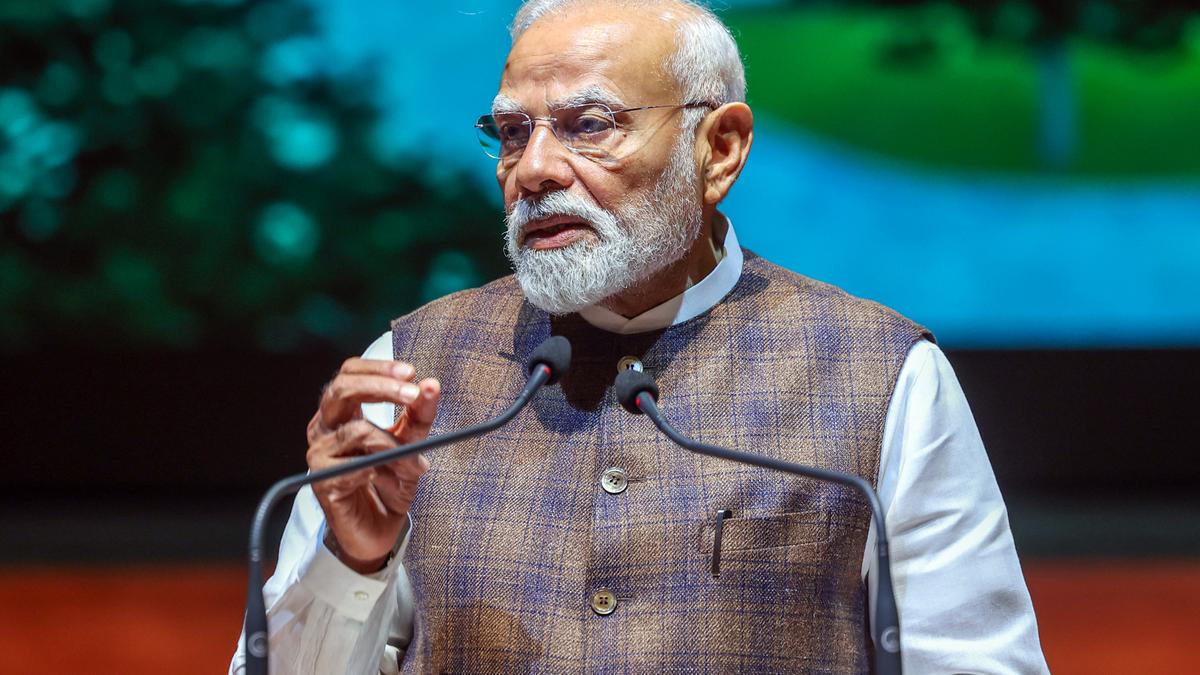
Justice Bagchi said the poll body had listed only “frequent migration” as one of the reasons for holding the SIR. File
| Photo Credit: The Hindu
The Supreme Court on Thursday (January 22, 2026) questioned whether the Election Commission of India had “clearly and eloquently” cited illegal, cross-border immigration as a reason for holding the Special Intensive Revision (SIR) of electoral rolls and verifying citizenship of registered voters.
The query from the Bench of Chief Justice of India Surya Kant and Justice Joymalya Bagchi came even as nearly 6.5 crore names were removed from draft electoral rolls published by the poll body in nine States and three Union Territories. Around 3.26 crore voters in Uttar Pradesh, one of the nine States where the second phase of the SIR was done, received notices asking them to attend hearings and show citizenship credentials.

Senior advocate Rakesh Dwivedi, for the Commission, argued that the poll body was authorised to verify citizenship under Article 324 of the Constitution. Article 326 made citizenship mandatory for a person to vote. He referred to the amendments made in the Citizenship Act in 2003, which made conditions for citizenship more stringent, requiring both parents of electors to be Indian citizens. The concept of ‘illegal immigrant’ was introduced in the 2003 amendment.

But Justice Bagchi said the poll body had listed only “frequent migration” as one of the reasons for holding the SIR. “Was the requirement of examination of citizenship in light of 2003 amendments to the Citizenship Act a trigger to hold the SIR in 2025? If so, that trigger does not have an eloquent expression in the SIR notification,” Justice Bagchi observed.

Mr. Dwivedi agreed that the reason of “illegal migration” could have been expressed “more clearly, more happily”.
Justice Bagchi said by ‘migration’ in the SIR notification, the poll body seemed to have been referring more to inter-State migration and not cross-border illegal movement. Verification of citizenship was not exactly needed if an elector had only moved from one State to another within the country.
Mr. Dwivedi responded that the term ‘migration’ would subsume both inter-State and trans-border movement. “We could have said ‘inter-State migration’, ‘intra-State migration’, ‘cross-border migration’ or use the one expression ‘migration’ to mean it all,” he said.
The judge, however, said there was a clear distinction between migration and illegal immigration.
“Migration, when it is inter-State, is always lawful. The word ‘migration’ means ‘lawful migration’. When you talk of inter-country migrations, it may amount to illegal immigration. In India, citizens are entitled to move to any part of the country. It is a fundamental freedom. The aspect of illegality comes only in the case of immigration. Your SIR order does not eloquently state that your SIR is also about illegal immigration… When it is migration simpliciter, we will interpret it as inter-State migration,” Justice Bagchi observed.
The Bench asked “what was really in the mind” of the poll panel when it started the SIR exercise.
“What was in your mind then, you say ‘rapid urbanisation, ‘frequent migration’ without clearly saying ‘illegal immigration’. Is it that now you are second-guessing the SIR,” the judge asked the poll body.
The Bench said over 20 years have passed since the last SIR. There has been an enormous movement of population. Urbanisation has spread. It was admitted that wrongful entries have occurred in the electoral roll. The court asked whether the poll panel wanted to focus on these reasons and give itself some “elbow space” or press on with the ‘illegal immigration’ angle.
“Are you defending that a special revision can go into the aspect of illegal immigration? If so, that is not clear,” Justice Bagchi asked.
Mr. Dwivedi said the other reasons given in the SIR notification was more than sufficient to hold an SIR. He clarified that the SIR, being legislative in character, must also take into consideration the 2003 amendments made in the citizenship law.
“This amendment came after the previous SIR. The amendment had never been applied in the intervening years, until now. Revision of electoral rolls had been done earlier on the basis of self-declaration of citizenship. This [SIR 2025] we found was an opportune time to take note of this statutory amendment of 2003 and examine citizenship for the purpose of preparing the electoral roll,” Mr. Dwivedi argued.
Published – January 22, 2026 10:17 pm IST