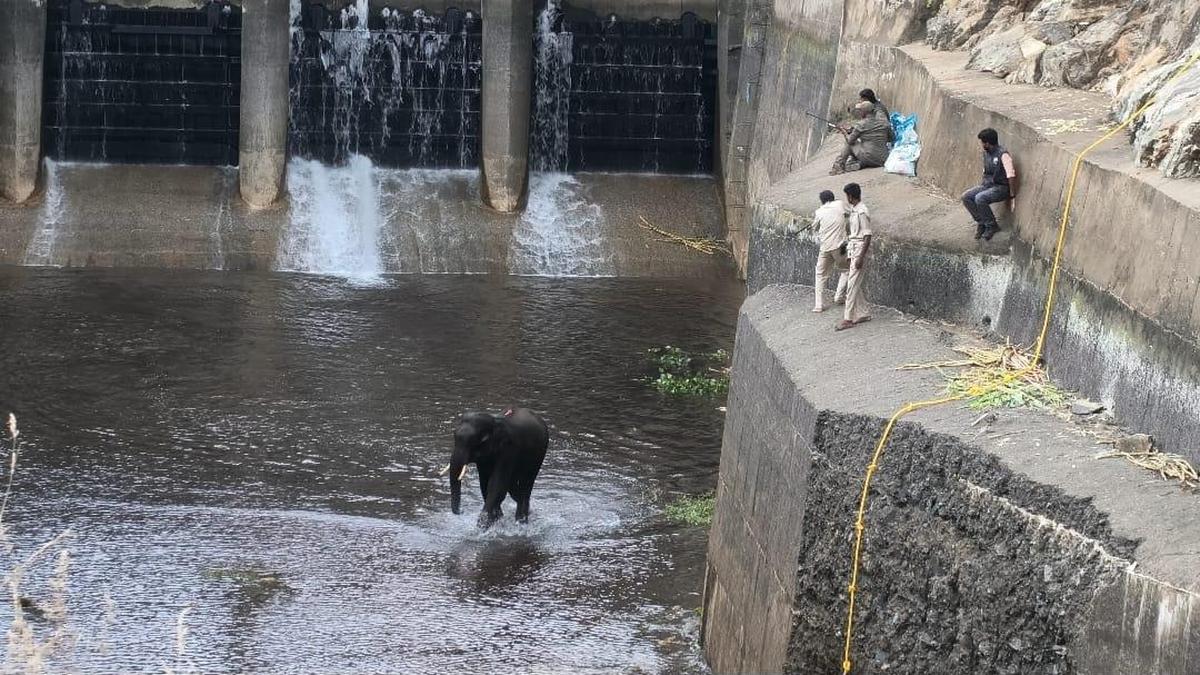
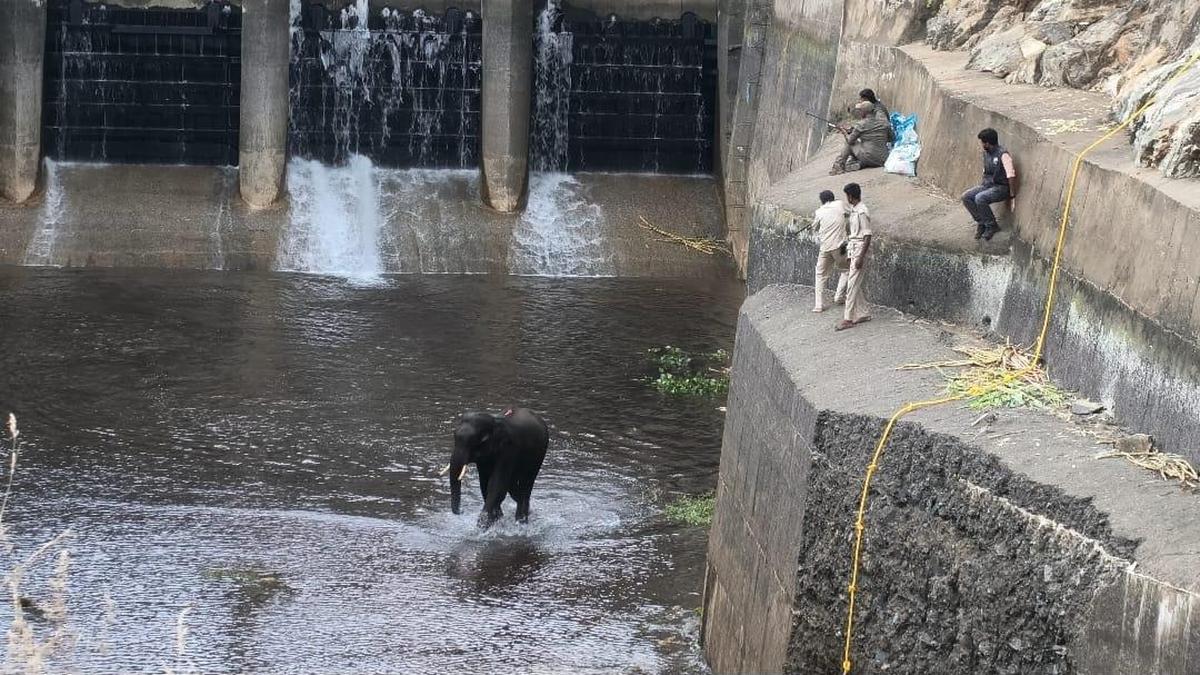
The elephant that was rescued from the canal supplying water to a private hydropower generation station near Shivanasamdura in Mandya district.
| Photo Credit: SPECIAL ARRANGEMENT
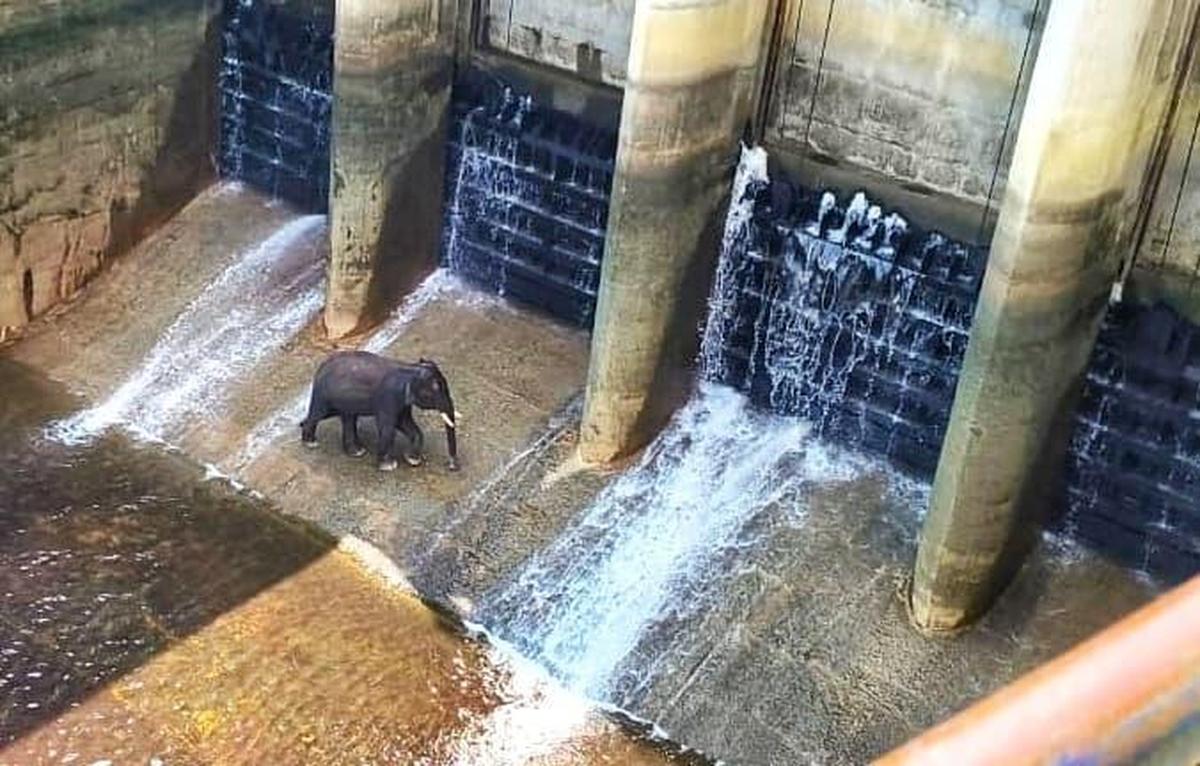
The elephant that was trapped in the canal supplying water to a power generating unit at Shivanasamudra in Mandya district.
| Photo Credit:
SPECIAL ARRANGEMENT
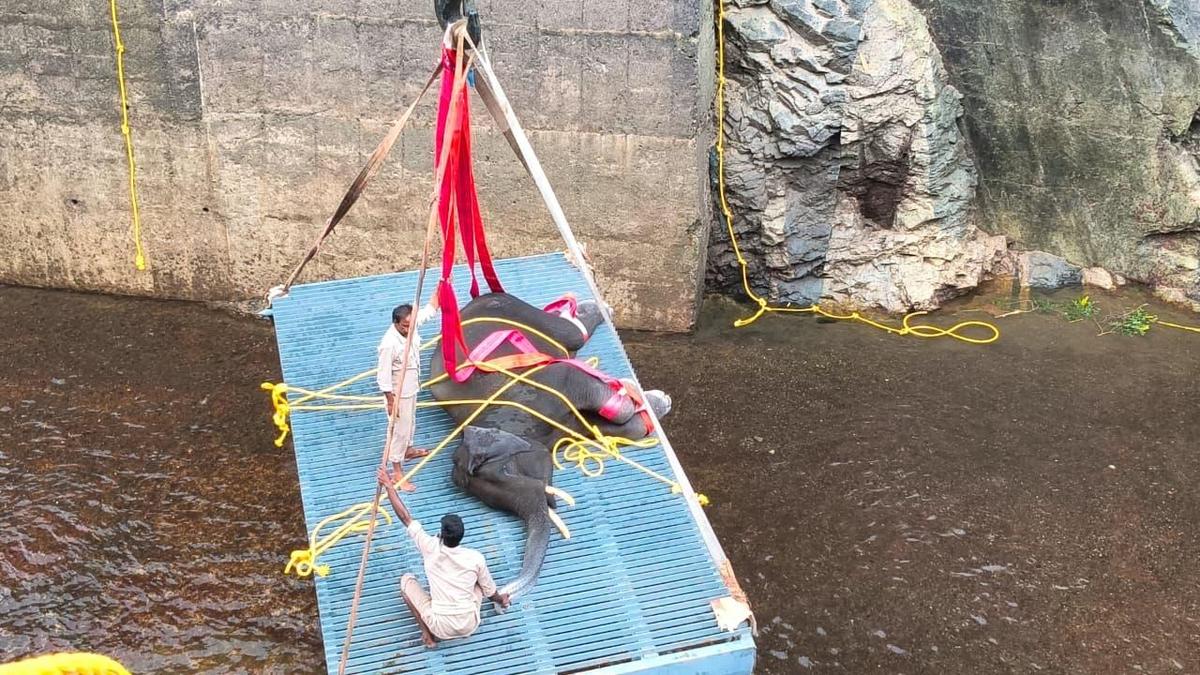
The trapped elephant being lifted from the canal to safety after being tranquilised, near Shivanasamudra, in Mandya district on Tuesday.
| Photo Credit:
SPECIAL ARRANGEMENT
A young tusker was successfully rescued and released back into the forest near Shivanasamudra in Malavalli taluk of Mandya district on Tuesday, after it was trapped for almost three days in the canal supplying water to a private hydropower generating plant.
The three-day operation ended successfully after the male elephant, estimated to be about 12 years, was safely lifted out of a 60-ft-deep power-generation canal, using heavy-duty cranes.
Prabhu Goud, Deputy Conservator of Forests, Mysuru territorial division, who oversaw the rescue mission, said that the animal, which had remained trapped in the fast-flowing canal since Sunday, was found to be uninjured and was later released into the Cauvery Wildlife Sanctuary which abuts the Shivanasamudra falls.
He said the elephant may have slipped into the canal around 11.15 a.m. on Sunday, either while attempting to drink water or while playing near the edge. Once inside, it was unable to extricate itself and climb out due to the high-velocity flow of water in the canal which is supplied to a hydropower plant run by Pioneer Jenco Ltd.
With the canal continuing to carry water at force, the Forest Department held discussions with the Krishnaraja Sagar and Kabini dam authorities to reduce the outflow from the two dams to the river and thus stabilise the situation.
Meanwhile, nearly 80 personnel monitored the elephant round-the-clock and ensured that the tusker was fed with sugarcane and fodder so that it did not collapse due to exhaustion and panic.
Mr. Goud said the actual extraction operation was a major logistical challenge. “An 80-tonne crane—usually deployed for hoisting metro coaches—had to be brought in from Bengaluru due to the absence of heavy-duty machinery in the region,” he said.
Besides, two additional cranes were positioned to assist in lifting the animal once darted and stabilised on a platform.
The critical phase came immediately after darting. There was real concern that once tranquilised, the elephant would collapse and though the outflow from the dam had stopped, there was enough water flow due to seepage.
“Water could enter the lungs and cause the elephant to die and hence precautions were taken to ensure that it was hoisted immediately on being tranquilised,” said Mr. goud.
It also entailed a lot of preliminary work like creating a platform strong enough to bear the load of the elephant and raise it to a height of 60 ft.
The entire operation took around 40 minutes, with all three cranes working in coordination to bring the elephant safely out of the 60-foot-deep canal.
After medical assessment confirmed that the animal had suffered no injuries, the antidote was administered, and the elephant scampered back into the sanctuary.
The officials described the effort as one of the most complex rescues in recent years which not only entailed teamwork but coordination from different departments, including the dam authorities, and the technical crew for the safe rescue and release of the elephant.
Published – November 18, 2025 06:35 pm IST